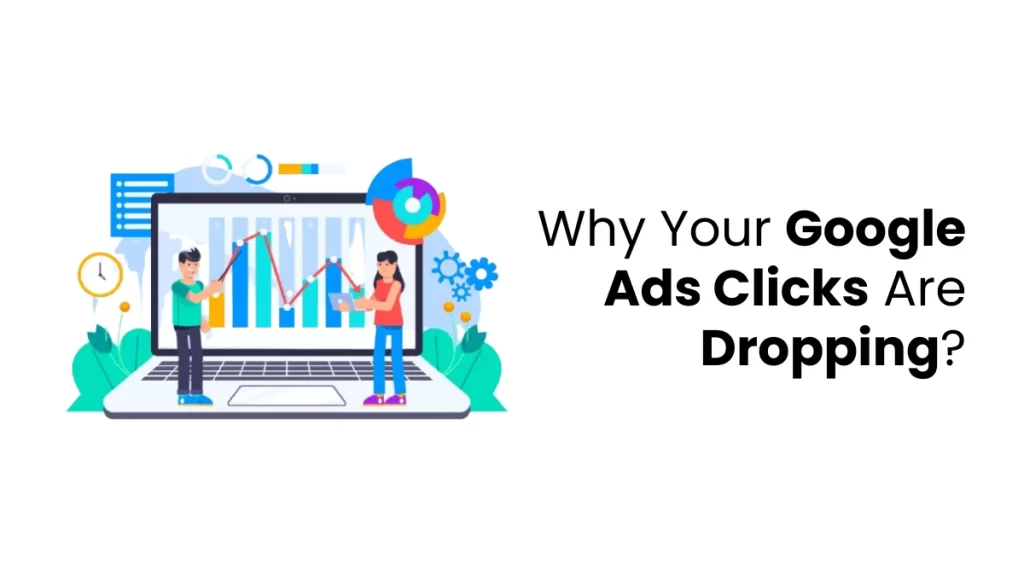
Google Search looks very different today, and Google Ads performance is changing with it. AI-generated summaries now take up more space in search results, competitors are offering stronger deals and promotions, and users are becoming more selective about what they click. Because of this, many campaigns are seeing lower click volumes even when budgets, keywords, and targeting remain the same.
A drop in clicks does not always mean your ads are performing poorly. Sometimes the issue is lower CTR, reduced impression share, changing search intent, or changes in Google’s search results layout. Understanding the actual reason behind the drop is important before making changes to your campaigns. This article explains the most common causes of declining Google Ads clicks and the factors to check before trying to fix them.
Are Your Impressions Also Dropping?
Before analyzing why clicks are declining, it is important to check whether impressions are also decreasing. A drop in impressions and a drop in clicks usually indicate different performance issues.
If both impressions and clicks are dropping, your ads may be losing visibility because of factors like:
- Increased competition
- Lower search demand
- Reduced impression share
- Budget limitations
- Poor Quality Score
- Bidding issues
Common Reasons Google Ads Clicks Are Declining
1. AI Overviews Are Changing Click Behavior
One of the biggest reasons behind falling Google Ads clicks is Google’s AI-powered search experience. For many searches, users now see AI-generated elements before they reach traditional ads or organic listings, including:
- AI Overviews
- Direct answers
- Summaries
- Featured snippets
- Videos
- Shopping results
This changes how users interact with search results. Your biggest competitor is no longer just another advertiser. Sometimes it is Google itself. Even if your ad is technically ranking well, it may now appear below a large AI-generated summary that already answers the user’s question.
This especially affects informational searches such as:
- ‘What is PPC?’
- ‘How Google Ads work?’
- ‘Best bidding strategy’
Users often get enough information directly on the search page without clicking anything. This is called a zero-click search.
This changes how users interact with search results. Your biggest competitor is no longer just another advertiser. Sometimes it is Google itself. Even if your ad is technically ranking well, it may now appear below a large AI-generated summary that already answers the user’s question.
This especially affects informational searches such as:
- ‘What is PPC?’
- ‘How Google Ads work?’
- ‘Best bidding strategy’
Users often get enough information directly on the search page without clicking anything. This is called a zero-click search.
In many cases, the goal is no longer just generating clicks. Features like Lead Form Extensions, Call Ads, and click-to-message campaigns allow users to convert directly from the search results page without visiting your website. This is known as a zero-visit conversion, where users can take action without visiting your website. Because of this, lower clicks do not always mean lower business results.
However, informational content still matters. The difference is that generic informational content performs poorly now. Businesses need deeper insights, practical analysis, strong opinions, case studies, or actionable strategies that AI summaries cannot fully replace.
What You Should Do
Instead of relying heavily on broad informational keywords, focus more on:
- Commercial intent keywords
- Buying-stage searches
- Action-oriented search terms
- High-conversion queries
For example:
‘Digital marketing course’ is weaker than:
‘Best digital marketing course with placement’
The second keyword reflects stronger buying intent and usually performs better.
You should also use Google Ads features that reduce dependence on website clicks, including:
- Lead Form Extensions
- Call Ads
- Click-to-Message features
These formats allow users to convert directly from the search results page.
2. Increased Competition in Google Ads Auctions
Google Ads works on a bidding system. As more advertisers target the same keywords, competition increases. When competition increases, CPC usually rises while visibility, impression share, and clicks may decline. Even well-optimized campaigns can lose traffic when competitors start spending more on the same keywords.
The Auction Insights report helps you understand whether competitors are overtaking you. Pay close attention to metrics like impression share, outranking share, overlap rate, and top-of-page rate to understand whether competitors are overtaking your ads. When competitors consistently appear above your ads, click volume can start dropping.
3. Your CTR Has Declined
If impressions are stable but clicks are falling, CTR is usually the first metric to check. A lower CTR usually indicates that users are not engaging with your ads as much as before.
Why CTR Drops
A declining CTR usually means users are seeing your ads but no longer finding them as relevant or useful as before. This can happen because of weak messaging, repetitive creatives, stronger competitor ads, or changes in user behavior.
Ad Fatigue
If you use the same headlines and descriptions for months, users stop noticing them. This is called ad fatigue.
However, constantly changing ad copy is also not a good strategy, especially with Responsive Search Ads and Smart Bidding systems. Frequent edits can reset Google’s learning phase and affect optimization.
Instead of updating ads randomly, use data-driven creative rotation based on:
- CTR trends
- Conversion performance
- Impression share changes
- Search term quality
Weak Ad Copy
Many ads fail because their messaging feels too generic or repetitive. Users should immediately understand:
- What you offer
- Why it matters
- Why they should click
If a competitor’s ad communicates stronger value through better offers, clearer pricing, customer reviews, free trials, or stronger CTAs, users are more likely to click their ad even when both ads appear in similar positions.
Ad Blindness
Users see ads constantly across search engines, social media, websites, and apps. Over time, repetitive ad styles and familiar messaging become easier to ignore. When ads start looking similar to everything else on the page, users are less likely to notice or click them.
4. Your Quality Score May Be Affecting Performance
Quality Score still plays an important role in Google Ads performance when your Quality Score drops, Google may show your ads less often or place them in lower positions.
This can lead to:
- Lower ad visibility
- Reduced impression share
- Lower CTR
- Weaker rankings
- Higher CPC
What Google Checks
Quality Score is not based on bidding alone. Google also looks at how relevant and useful your ads are for users.
Expected CTR: Measures how likely users are to click your ad.
Ad Relevance: Checks how closely your ad copy matches user intent.
Landing Page Experience: Evaluates whether your landing page is relevant, useful, and fast.
5. Poor Landing Page Experience
Check: Mobile Speed & UX
Many businesses spend a lot of time optimizing ads but pay very little attention to the landing page.
If the landing page is slow, irrelevant, or difficult to use, it can affect:
- Quality Score
- Conversions
- User engagement
- Overall ad performance
Slow Loading Speed
Page speed has a direct impact on both user experience and ad performance. When a landing page takes too long to load, many users leave before interacting with the content.
Poor Mobile Experience
Most ad traffic now comes from smartphones, so mobile usability plays a major role in performance. If your landing page is cluttered, slow, difficult to navigate, or hard to read, users are more likely to leave without taking action.
Offer Mismatch
When users click an ad expecting something specific but land on unrelated content, trust is immediately lost. To maintain consistency and improve conversions, your keywords, ad copy, and landing page should align with the same user intent.
6. Search Intent Has Changed
Many campaigns don’t perform well because advertisers continue targeting search behavior that has already changed. Search intent changes over time based on user habits, technology, and market trends.
For example:
- Users may now prefer video explanations
- AI tools may already answer basic informational queries
- Customer expectations may change
- Buying behavior may vary
Because of this, keywords that worked well earlier may not deliver the same results today. This is why many digital marketing institutes in Kochi now focus more on audience intent, real campaign analysis, and performance strategy instead of outdated keyword-only approaches.
Why Intent Matters
A person searching ‘learn Google Ads’ has a very different intent compared to someone searching ‘best Google Ads course with certification.’ The second search shows stronger buying intent, which usually leads to better conversion opportunities.
Understanding search intent helps improve:
- Targeting
- CTR
- Lead quality
- Conversions
because you are matching your ads with what users actually want at that moment.
7. Poor Keyword Match Types and Negative Keywords
Check: Search Terms & Exclusions
Keyword targeting issues can quietly reduce clicks over time, even when the campaign setup looks correct. If match types are not set properly, your ads may either show for irrelevant searches or miss out on useful ones.
Common issues include:
- Unmonitored broad match triggering unrelated searches
- Exact match limiting reach too much
- Negative keywords block useful traffic
Regularly reviewing search terms, match types, and negative keyword lists helps keep your traffic relevant and your click performance stable.
Unmonitored Broad Match Problems
Broad Match is not inherently bad. In campaigns using Smart Bidding and strong conversion tracking, it can help discover high-converting search variations that Exact Match may miss.
However, without proper negative keyword management and search term monitoring, Broad Match can still attract irrelevant traffic. This can reduce CTR, waste budget, and lower overall ad relevance.
Overly Restrictive Targeting
Using only exact match keywords can reduce overall visibility and limit reach. It may also prevent your ads from appearing for relevant search variations that could still bring qualified traffic and conversions.
Negative Keyword Mistakes
Incorrect negative keywords can accidentally block relevant searches and reduce your reach. This often happens when exclusions are added without properly reviewing search terms.
What to Check
Review your:
- Search terms report
- Match type performance
- Irrelevant traffic patterns
- Negative keyword list
This helps identify hidden traffic losses affecting clicks.
8. Smart Bidding May Be Filtering Your Traffic
Smart bidding strategies can affect how your ads are shown and who sees them, which may impact overall click volume.
If you use:
- Target CPA
- Maximize Conversions
- Target ROAS
Google’s AI may intentionally reduce low-quality traffic. Sometimes the system identifies users who are unlikely to convert and stops showing ads to them.
As a result:
- Clicks may decrease
- Conversion quality improves
This is why campaigns should never be evaluated using clicks alone.
Another major factor today is first-party data. As third-party cookies continue disappearing, Google relies more heavily on customer data signals. Providing stronger first-party data through Customer Match lists, Enhanced Conversions, and CRM integrations can help Smart Bidding systems identify higher-quality audiences more accurately.
Understanding how automation, audience signals, and conversion tracking work has become an important part of modern digital marketing courses in Kochi.
Final Thoughts
Google Ads is not as predictable as it used to be. AI-generated results, stronger competition, privacy-driven targeting changes, and changing search behavior are all affecting how users interact with ads. Because of this, a drop in clicks should not be treated as a simple issue. The important thing is understanding what is actually causing the decline before making optimization changes.
For professionals seeking digital marketing training in Kochi, Finprov Learning offers practical programs focused on Google Ads, PPC strategy, campaign analysis, SEO, and real-world digital marketing skills. Navigating these AI-driven shifts is a core focus of the curriculum, with more emphasis on live campaign analysis, automation, audience behavior, and performance strategy rather than outdated theoretical learning.
FAQs
Why are my Google Ads clicks dropping suddenly?
Google Ads clicks usually drop because of lower CTR, stronger competition, AI Overviews, budget limitations, or weaker targeting signals.
Why are my ads getting impressions but no clicks?
This usually indicates a CTR problem caused by weak ad copy, poor offers, irrelevant targeting, or stronger competing ads.
Can AI Overviews reduce Google Ads clicks?
Yes. AI Overviews answer many informational queries directly on the search page, reducing the need for users to click through websites.
Does Quality Score still matter?
Yes. Quality Score affects visibility, rankings, CPC, and impression share. Poor relevance or landing page experience can reduce performance significantly.
How can I improve Google Ads CTR?
Improve CTR by strengthening ad copy, improving keyword targeting, matching user intent more accurately, and testing creatives using performance data instead of random changes.