Introduction
Data analytics is changing faster than ever, and many of the technologies that once felt futuristic have already become part of everyday business operations. Generative AI, AI agents, real-time analytics, and cloud-based platforms are no longer just buzzwords or experimental projects. They are actively helping organisations make better decisions, automate tasks, and uncover insights faster than ever.
At the same time, the way companies handle data is becoming more challenging. Data is no longer stored in one place; it comes from websites, apps, cloud platforms, connected devices, and many other sources. As data volumes grow, businesses also need to take privacy, security, and the responsible use of AI more seriously. New regulations and changing expectations are pushing organisations to find the right balance between innovation and accountability.
One of the biggest advantages of advanced analytics is that it is no longer limited to data experts. AI-powered tools are making it easier for anyone to explore data, create reports, and discover insights through simple prompts and natural conversations. In this article, we’ll look at ten key trends shaping the future of data analytics and why they matter.
What Are the Top Data Analytics Trends in 2026?
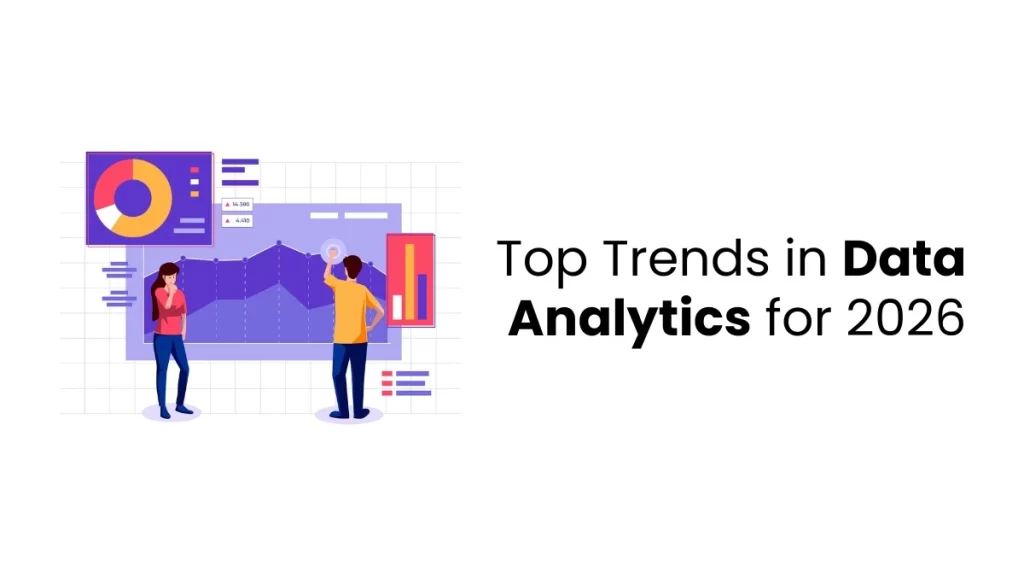
Data analytics is no longer just a tool for creating reports. Today, it helps businesses make faster decisions, improve customer experiences, and stay ahead of competitors. As technology evolves, new trends are changing how organisations collect, manage, and use data.
Let’s explore some of the biggest data analytics trends shaping 2026.
1. Growing Importance of Big Data Analytics
The days of waiting weeks to analyse business data are quickly disappearing. Today, organisations are focusing on real-time data analysis to make faster and smarter decisions.
When organisations can access and analyse data instantly, they can react more quickly to changing customer demands and business challenges. Real-time insights help them make smarter decisions and stay ahead of the competition.
2. Wider Adoption of Generative AI and RAG
Generative AI is transforming the way businesses work with data. It can help create reports, generate insights, automate content creation, and even build synthetic datasets for analysis.
Retrieval-Augmented Generation (RAG) provides AI with up-to-date information to generate responses. Combined with GenAI, this automation improves organisational data use and the efficient completion of complex tasks.
3. Improving data quality and veracity
Data volumes are growing every day. So keeping everything accurate becomes harder. When data is incomplete or inconsistent, it can easily lead to poor decisions, which is why managing data quality has become so important. Modern tools can help spot unusual patterns or errors in datasets, but that alone is not enough. Companies also need to fix issues at the source. This means using reliable data inputs, keeping systems consistent, and reducing mistakes as data moves through different pipelines.
Data observability allows this by giving teams a clearer view of overall data health. It looks at five key areas: freshness, schema, volume, distribution, and lineage. Together, these help teams track how data behaves and catch problems early, before they affect real business decisions.
4. Scalable cloud-based data platforms
Cloud computing has made storage and processing almost unlimited. Organisations no longer need physical infrastructure and can scale resources up or down as needed. Platforms like Snowflake, Amazon Redshift, Google BigQuery, and Databricks support large-scale data work across teams. BI tools like Tableau, Domo, and Zoho Analytics help turn complex data into simple dashboards and reports for easier understanding.
5. Rise of Real-Time and Predictive Analytics
Forward-looking companies demand predictive analytics systems that identify upcoming opportunities and flag potential risks in advance.
Both real-time and predictive analytics enable organisations to identify opportunities and reduce risks proactively, a growing necessity for companies that need fast insights to drive growth.
6. Growth of No-Code and Low-Code Analytics
A shortage of technically skilled employees is driving organisations to adopt no-code and low-code analytics tools that enable users to build pipelines and reports with minimal coding.
This change motivates more employees to lead data initiatives independently of IT teams.
7. Focus on Responsible AI and Data Ethics
AI is becoming an essential part of data analytics, but using it properly is important. Companies are working to make sure their AI systems are fair and transparent. As AI adoption continues to grow, ethical AI and proper data management will be key to maintaining customer confidence.
8. Data as a Product and Monetisation
Data is increasingly being treated as a business asset. Instead of only supporting internal decision-making, organisations are packaging data into “data products” with defined ownership, quality standards, and service-level agreements.
Some companies are even monetising their data externally. For example, financial firms sell market insights, retailers provide consumer behaviour analytics, and logistics companies offer supply chain intelligence.
This shift changes how analytics teams operate. They now work like product teams, focusing on user needs, roadmaps, and measurable outcomes.
9. Modular and Composable Data Architectures
Organisations are moving away from large, rigid systems and shifting toward more flexible, modular setups. Instead of relying on a single platform for everything, they now use different tools for storage, processing, transformation, and visualisation, all connected via APIs.
This approach gives them more freedom. They can upgrade or replace parts of the system without starting from scratch, avoid dependence on a single vendor, and adopt new technologies much more quickly.
10. Evolution of BI through NLP
Natural Language Processing (NLP) is changing Business Intelligence (BI) by making data interaction more intuitive and efficient. Language now acts as a bridge between users and data, enabling natural text prompts to become analytical queries. NLP-powered systems can analyse unstructured data such as customer feedback, identify trends, summarise insights, detect anomalies, and generate meaningful narratives from complex datasets. This evolution helps organisations accelerate decision-making while improving accessibility and a deeper understanding of business information.
The Future of Data Analytics Beyond 2026
The future of data analytics goes far beyond new tools and technologies. It is changing the way businesses make decisions, solve problems, and create value. As organisations continue to generate more data, analytics will become an even more important part of everyday business operations.
Stronger Collaboration Between Humans and AI
AI will not replace human expertise. Instead, it will work alongside employees to help them make better decisions. While AI can quickly process large amounts of data and identify patterns, humans will provide context, creativity, and strategic thinking. This partnership will help businesses gain deeper insights and improve outcomes.
More Connected and Integrated Data Ecosystems
Organisations will increasingly connect data from different platforms, applications, and departments into a single ecosystem. This will reduce data silos and give teams a complete view of their operations, customers, and business performance. Better integration will also make data more accessible across the organisation.
Predictive and Prescriptive Analytics Will Become the Norm
Businesses will move beyond understanding what happened in the past. Analytics tools will not only predict future outcomes but also recommend the best actions. This will help organisations reduce risks, improve efficiency, and make more confident decisions.
Data Literacy Will Become a Core Business Skill
As analytics becomes more available, employees across all departments will be expected to understand and use data in their daily work. Companies will invest more in data literacy programs to help their teams interpret insights and make data-driven decisions.
Greater Focus on Privacy and Responsible Data Use
As concerns about data privacy grow, businesses will need to manage customer information more carefully. Strong governance policies, transparent practices, and the ethical use of AI will become mandatory to maintain customer trust and meet regulatory requirements.
Analytics Will Be Embedded Into Everyday Workflows
In the future, employees may not need to open separate analytics platforms to access insights. Analytics will be built directly into the tools they already use, allowing them to receive recommendations and insights while working. This will make decision-making faster and more efficient.
As data continues to grow in importance, organisations that adopt these changes will be better prepared to innovate, adapt, and compete in an increasingly digital world.
Conclusion
Data analytics is becoming increasingly significant to businesses each year. The trends we see in 2026 show that companies are focusing on faster insights, smarter decision-making, and better data use. Technologies like AI, real-time analytics, cloud platforms, and no-code tools are making it easier for organisations to understand their data and take action.
Businesses that adopt these changes will be better positioned to work more efficiently, better understand their customers, and grow in a competitive market. At the same time, demand for data analytics skills is expected to continue increasing across industries.
If you are interested in starting a career in data analytics, joining a data analytics course in Kochi can be a big step. It can help you learn the essential skills for working with data, generating insights, and preparing for the future of analytics.
FAQs
1. Why is data analytics important for businesses?
Data analytics helps businesses understand what is happening in their organisation. It helps businesses understand customer preferences, identify issues, and make better decisions based on real data.
2. What are the biggest data analytics trends in 2026?
Some of the key trends include real-time analytics, Generative AI, predictive analytics, cloud-based analytics platforms, no-code tools, and a stronger focus on data privacy and responsible AI.
3. How does Generative AI help in data analytics?
Generative AI can help summarise data, create reports, identify patterns, and provide insights more quickly. This helps businesses save time and make informed decisions faster.
4. What is predictive analytics?
Predictive analytics uses existing and historical data to forecast future outcomes. Businesses use it to anticipate customer behaviour, reduce risks, and identify new opportunities.
5. What are no-code and low-code analytics tools?
These tools let users analyse data and automate tasks without coding skills, making analytics accessible to non-technical users.