Introduction
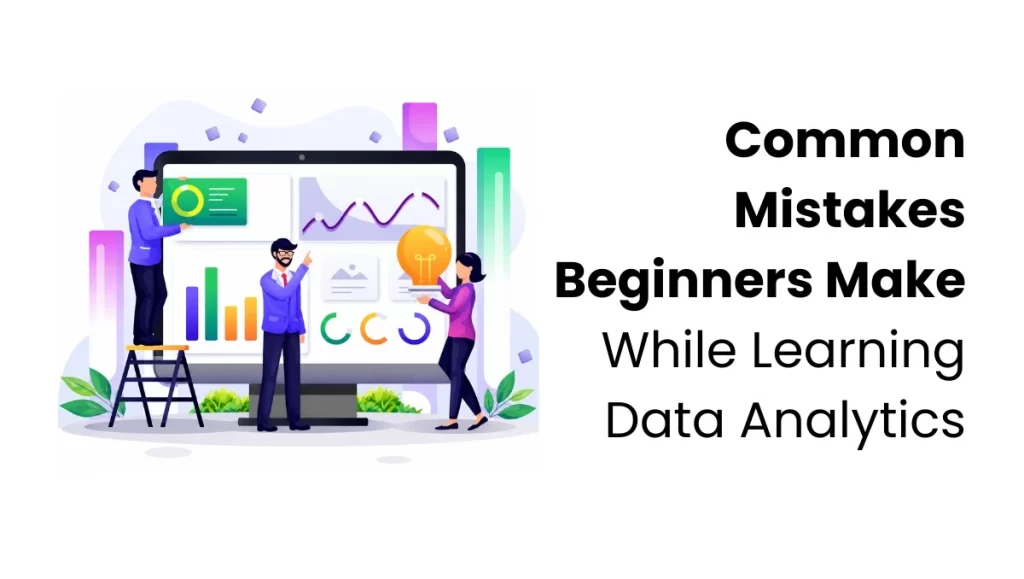
Data analytics has become one of the most popular career choices today. Companies use data to make better decisions, solve business problems, and improve their performance. This has created many opportunities for those seeking to build a career in data analytics. However, many beginners make common mistakes while learning. These mistakes can slow their progress, make learning more difficult, and leave them feeling discouraged.
These challenges often happen because learners skip the basics, focus too much on tools, or follow an unstructured learning path. Students can completely avoid these mistakes with an effective learning strategy and proper guidance.
In this blog, you will learn about the most common mistakes beginners make while learning data analytics. This guide will help you build a strong foundation, avoid common learning mistakes, and make the most of your data analytics learning journey.
Mistakes to Avoid While Learning Data Analytics
Skipping the Fundamentals of Data Analytics
Many beginners are excited to learn popular tools such as Power BI, Tableau, and Python. As a result, they often skip the basics and move straight to advanced topics. However, learning tools without understanding the fundamentals can make data analytics much more difficult later. It’s like trying to drive a race car before learning how to drive a regular car.
The basics of data analytics make everything else easier to learn. When you understand how data works and how to work with it, you can pick up new tools more quickly and use them with confidence. A strong foundation also helps you analyse data accurately and solve real business problems more effectively.
How to Avoid It
Before moving on to advanced tools, build a strong understanding of the fundamentals. Start with descriptive statistics, data visualisation principles, database concepts, Excel and SQL. Once you understand these basics, learning tools like Power BI and Python will become much easier.
Trying to Learn Too Many Tools at Once
Many students try to learn every data analytics tool at once. They start learning Excel, SQL, Python, Power BI, Tableau, and other tools together, assuming it will help them become job-ready faster. However, managing multiple tools at once can become overwhelming and slow down their progress.
Each tool requires time and practice to understand properly. Instead of trying to master everything together, focus on one skill at a time. Building a strong understanding of each tool will help you apply your knowledge better and make the learning process smoother.
How to Avoid It
Follow a structured learning path and learn tools step by step:
| Stage | Skills to Learn |
| Beginner | Excel, Basic Statistics |
| Intermediate | SQL, Power BI |
| Advanced | Python, Machine Learning |
By following a proper roadmap, you can build your skills gradually and become more confident as you progress.
Ignoring SQL While Focusing Only on Python
Students spend most of their time learning Python because it is one of the most popular skills in data analytics. While Python is important, ignoring SQL is a common mistake. In most data analytics roles, you will use SQL to access and work with data before you analyse it using Python or other tools.
Learning Python without SQL can make it harder to work on real projects. Both tools have different purposes, and they work best when used together. If you want to become a skilled data analyst, it is important to build your knowledge in both.
How to Avoid It
Instead of focusing only on Python, learn SQL alongside it. Start with simple SQL queries and practise working with databases. Once you are comfortable with SQL, use Python to analyse and visualise the data. Learning both tools step by step will better prepare you for data analytics roles.
Not Working on Real Data Analytics Projects
Learning data analytics through videos, courses, and books is important, but theory alone is not enough. To become qualified, you need to apply what you learn to real datasets and business problems. Having practical experience will help you understand how data analytics works in a professional setting.
Recruiters often ask about data analytics projects during interviews because projects showcase your practical skills. For example, completing online tutorials is useful, but if you cannot analyse a real business dataset on your own, it can be difficult to demonstrate your abilities.
How to Avoid It
Try working on small projects while you are learning. You can create a sales dashboard, analyse customer churn, measure marketing campaign performance, or explore financial data. These projects will strengthen your portfolio and help you stand out during job interviews.
Ignoring Statistics and Math Basics
Statistics may seem difficult at first, so many learners try to avoid them and focus only on tools. However, understanding basic statistics is an important part of data analytics. While tools can perform calculations, they cannot help you understand what the results actually mean.
Concepts such as mean, median, correlation, probability, and hypothesis testing help you better understand your data. They make it easier to identify patterns, interpret results correctly, and make better decisions based on the data rather than simply accepting what the tools generate.
How to Avoid It
You do not need to become a maths expert, but you should know the basic statistical concepts used in data analytics. Learn one concept at a time and practise using it with real datasets. As your understanding grows, analysing and interpreting data will become much easier.
Memorising Instead of Understanding Concepts
Many learners try to memorise formulas, SQL queries, or Python syntax without understanding how they work. This may help while following tutorials, but it becomes difficult to solve real problems when the situation changes. Data analytics is not about remembering every step. It is about understanding the logic behind the process.
When you understand why a method is used and how it works, applying it to different datasets and business problems becomes much easier. A clear understanding also helps you learn new tools and concepts more quickly.
How to Avoid It
Instead of trying to remember formulas or code line by line, focus on understanding how they work and why they are used. When the concepts are clear, it becomes much easier to solve different types of problems. The best way to learn is to practise with different datasets and apply what you have learned in real situations.
Focusing Only on Certifications
Getting a certification is a good step, but it should not be your only goal. Many learners believe that collecting more certificates will increase their chances of getting hired. In reality, employers want to see how well you can apply your knowledge to solve real problems.
When you attend job interviews, recruiters are more interested in seeing what you can actually do with data. They look at your projects, portfolio, problem-solving skills, and how you approach real business problems. These give them a better idea of your abilities than simply looking at the number of certificates you have earned.
How to Avoid It
A certification can help you get noticed, but your skills are what make the real difference. Make time to work on real projects, build a portfolio, and keep practising what you learn. This will help you handle interviews more effectively and prepare you for the challenges of a real data analytics job.
Choosing the Wrong Course or Learning Path
The course you choose can shape your entire learning experience. Some courses teach only the theory, while others do not give you enough opportunities to practise what you learn. This can make it difficult to apply your knowledge when you start working on real data analytics projects or attend job interviews.
A good data analytics course should help you build skills step by step through hands-on practice, real projects, and guidance from experienced trainers. It should prepare you for the kind of work you will do in a real job, not just help you complete lessons.
How to Avoid It
Do not choose a course based only on advertisements or certificates. Spend some time checking the course content, the projects included, the tools you will learn, and the support provided after training. If you are looking for practical learning, Finprov’s Data Analyst Course in Bangalore gives you hands-on experience with real projects, industry-relevant tools, and expert guidance to help you become job-ready.
Not Building a Portfolio Early Enough
A portfolio is one of the best ways to show what you can do as a data analyst. Many learners wait until they finish their course or feel fully prepared before creating one. However, waiting too long can make it harder to showcase your skills when applying for jobs.
Your portfolio gives employers a clear idea of your practical experience and how you approach real data problems. It is not just a collection of projects; it shows your ability to analyse data, find insights, and present your work effectively.
How to Avoid It
Start building your portfolio while you are learning. Add projects step by step, such as SQL projects, Power BI dashboards, Excel analysis reports, Python projects, and real-world case studies. A well-prepared portfolio can help you stand out and make a stronger impression during your job search.
Giving Up Too Early
Learning data analytics doesn’t happen overnight. At the beginning, you may find some topics difficult, such as writing complex SQL queries, understanding statistics, or fixing errors in your projects. These efforts are a normal part of the learning process, but they can make some learners feel like giving up.
Learning data analytics takes time, so do not get discouraged when things feel difficult at first. Every challenge you face helps you improve and better understand concepts. With regular practice and effort, topics that seem confusing today will become much easier over time.
How to Avoid It
Do not rush your learning process or expect to understand everything immediately. Take one step at a time, practise consistently, and focus on gradually improving your skills. When you face difficulties, treat them as part of the learning journey and use them as opportunities to improve.
Conclusion
Learning data analytics is a journey, and it takes time to become comfortable with concepts, tools, and real data problems. It is completely normal to face challenges while learning, but the important thing is to keep improving and not give up.
Focus on learning the basics properly, practise what you learn, and apply your skills through real projects. Do not rush to complete everything quickly. Take your time, learn step by step, and keep improving with every project you work on. With regular practice and hands-on experience, you can develop the skills needed to become a successful data analyst and move closer to your career goals.
FAQs
1. What are the most common mistakes beginners make while learning data analytics?
Many beginners make simple mistakes while learning data analytics, such as skipping the basics, focusing only on tools, trying to learn too many things at once, or not working on real projects. Some also rely solely on certifications, without developing practical skills. These mistakes can slow down their learning and make it harder to become a job-ready data analyst.
2. Should I learn Power BI or Python first for data analytics?
It depends on your learning goals, but it is better to start by understanding the basics of data analytics, Excel, and SQL. Once you have a strong foundation, you can gradually learn tools like Power BI and Python based on your career goals.
3. Is SQL necessary for a data analyst?
Yes, SQL is an important skill for data analysts. Most companies use databases to store data, and SQL helps analysts access, filter, and manage that data before analysing it. Learning SQL along with tools like Python and Power BI can improve your job opportunities.
4. Can I become a data analyst by only completing online courses and certifications?
Courses and certifications help learn the basics, but they are only one part of the journey. To become a skilled data analyst, you also need to practise with real datasets, work on projects, and apply what you learn in real situations. A good portfolio helps you showcase your skills and gives employers a better idea of what you can do.
5. Do I need strong mathematics skills to learn data analytics?
You do not need to be an expert in mathematics to learn data analytics. However, understanding basic statistical concepts such as mean, median, correlation, probability, and hypothesis testing is important for analysing data and making accurate decisions.