A sales report can tell you what happened. A customer report can tell you who bought. A marketing report can tell you where those customers came from. Looking at these reports separately gives you useful information, but it doesn’t always show you how everything connects.
That is why simply having data is not enough. Businesses also need a way to combine information from different sources and analyse it. A data warehouse makes this possible.
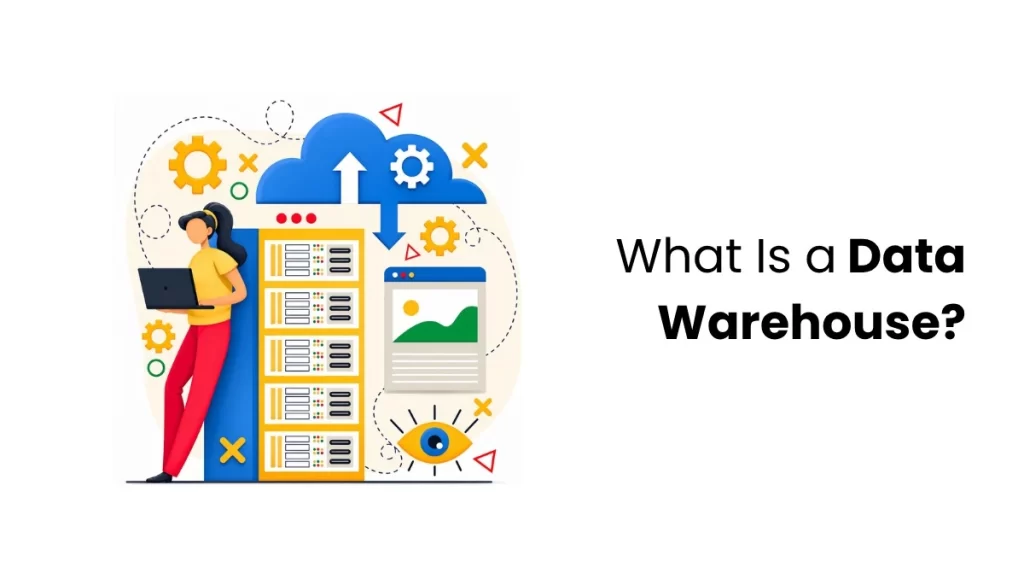
A data warehouse is a central system that collects data from different systems and stores it in an organised form for reporting and analysis. It can bring together current and historical data from sources such as sales systems, websites, customer relationship management (CRM) platforms, and marketing tools.
The easiest way to understand a data warehouse is to think about what happens inside a growing retail business.
The company may have one system recording purchases from its physical stores, another handling website orders, a CRM containing customer information, and separate platforms tracking marketing campaigns. Each system does its own job, but looking at all this information together can be difficult.
A data warehouse brings this information together. Once the data is collected, cleaned, and organised, analysts can use it to create reports, compare performance, identify trends, and answer business questions. Simply, a data warehouse makes data from different places easier to analyse.
How Does a Data Warehouse Work?
The process can be simplified into four main stages:
- Data Sources
- Data Integration
- Data Warehouse
- Analysis & Reporting
Let’s take a retail company as an example to see how this works.
1. Data Sources
The data warehouse first needs data to work with. This data can come from different systems used by the business.
For our retail company, the sources might include:
- Website and mobile app
- Store sales systems
- CRM
- Inventory system
- Marketing platforms
- Finance systems
Each system stores different information about the business.
2. Data Integration
The data from these sources cannot always be moved directly into the warehouse. It may contain duplicate records, inconsistent formats, missing values, or other issues.
This data is usually processed using ETL or ELT.
ETL stands for Extract, Transform, Load:
- Extract: Data is collected from different sources.
- Transform: The data is cleaned, standardised, and prepared.
- Load: The prepared data is moved into the data warehouse.
For example, one system might record a customer’s location as Kochi, while another uses Cochin. During transformation, these values can be standardised so they are treated consistently in reports.
Modern data platforms may also use ELT (Extract, Load, Transform), where data is loaded first and transformed within the target system.
3. Data Warehouse
Once the data has been prepared, it is stored in the data warehouse.
The warehouse can hold large amounts of current and historical data in a structure designed for querying and analysis. This allows the retail company to compare today’s sales with previous months or years without having to search through every individual source system.
4. Analysis and Reporting
The final step is using the stored data.
Analysts and business teams can connect reporting and Business Intelligence (BI) tools to the warehouse to create dashboards, reports, and analysis.
For example, the retail company could compare sales by product, location, month, or customer group and use those findings to understand how the business is performing.
What Are the Main Components of a Data Warehouse System?
A data warehouse is more than just a place to store data. Different components work together to collect, organise, and make the data available for analysis.
Data Sources
These are the systems where the original data comes from, such as CRM software, sales systems, websites, applications, and other business platforms.
ETL or ELT Tools
These tools help extract data, clean and transform it, and move it into the warehouse. The exact process depends on the data architecture being used.
Data Storage
This is where the prepared data is stored and organised so it can be used for analysis.
Schema and Data Organisation
Once data is stored in a data warehouse, it needs to be organised in a way that makes it easier to analyse. This is where a schema becomes useful. A schema defines how data is arranged in tables and how those tables relate to each other.
Two common approaches are:
- Star schema: A central table is connected to related tables around it. It is relatively simple and commonly used for analytical queries.
- Snowflake schema: Similar to a star schema, but the related tables are further divided into smaller, more structured tables. This can reduce data redundancy, but it also makes the structure more complex.
These schemas help organise warehouse data so analytical queries and reporting can be managed more effectively.
Metadata
Metadata is information that describes the data. It can tell users what a particular field means, where the data came from, or how it has been organised. This makes large datasets easier to understand and manage.
BI and Reporting Tools
These tools allow users to work with the data in the warehouse. They can be used to create reports, dashboards, charts, and other forms of analysis.
What Are the Types of Data Warehouses?
Businesses use different types of data warehouses depending on what they need. Three commonly used types are Enterprise Data Warehouse (EDW), Operational Data Store (ODS), and Data Mart.
Enterprise Data Warehouse
An Enterprise Data Warehouse collects data from across an organisation into a central system.
For example, a large retail company could combine sales, finance, customer, inventory, and marketing data so different teams can work from a consistent source.
Operational Data Store
An Operational Data Store (ODS) is designed to provide a more current and integrated view of operational data. It is often used when organisations need information from different operational systems in one place for reporting or operational decision-making.
A traditional data warehouse is often used for historical analysis, while an ODS focuses more on current or near-current information.
Data Mart
A data mart is a smaller collection of data focused on a specific department or business area.
For example, a retail company might have a sales data mart for the sales team and a marketing data mart for the marketing team. A data mart can be part of a larger data warehouse and gives a specific team easier access to the information it needs.
What Is a Data Warehouse Used For?
Businesses use data warehouses to work with information collected from different systems and use it for analysis. Instead of looking at each source separately, teams can use the data warehouse to get a broader view of business performance.
Business Reporting
A data warehouse can combine data from different business systems to create reports and dashboards. This makes it easier for teams to track sales, revenue, expenses, and other important business metrics.
Sales Analysis
A retail business can analyse sales by product, location, time period, customer group, or sales channel. This can help teams see which products or locations are performing better.
Customer Analysis
By combining customer information with purchase history, businesses can understand buying patterns, customer behaviour, and purchasing trends.
Trend Analysis
A data warehouse can store data over long periods, allowing businesses to compare performance across different time periods and identify changes or patterns.
Performance Monitoring
Teams can use dashboards and reports to track important business metrics and see how different areas of the organisation are performing.
What Is an Example of a Data Warehouse?
Consider a retail company that sells clothing through physical stores and an online shop.
Its website records online purchases. Store systems record offline sales. The CRM stores customer information, while the inventory system tracks available products. Marketing platforms provide information about campaigns and customer responses.
Without a data warehouse, each team may look at its own set of numbers. With a data warehouse, this information can be brought together. This allows the company to answer questions such as:
- Which products sell best online and in stores?
- Which locations generate the most revenue?
- How have sales changed compared with last year?
- Which marketing campaigns bring in customers who actually make purchases?
- Which products are frequently purchased together?
The company can get more useful answers by connecting the data instead of looking at each source separately.
What Is the Difference Between a Database and a Data Warehouse?
A database and a data warehouse both store data, but they are built for different purposes.
A database is commonly used to support day-to-day operations. For example, when a customer places an online order, the database records the order, updates the customer’s details, and helps the application get the information it needs.
A data warehouse is mainly designed for analysis. It can collect data from multiple systems and store historical information, making it easier for users to create reports and identify trends.
| Database | Data Warehouse |
| Supports daily business operations | Supports analysis and reporting |
| Often focuses on current transactional data | Can store large amounts of historical data |
| Supports applications and transactions | Supports BI, reporting, and analytics |
| Frequently handles inserts and updates | Optimised for analytical queries |
| Usually serves a specific application or process | Can combine data from multiple systems |
The two are used for different purposes. A business may use databases for everyday operations and a data warehouse to analyse the information from those systems.
What Is the Difference Between a Data Warehouse and a Data Lake?
A data warehouse and a data lake both store data, but they handle it differently.
A data warehouse generally contains cleaned, processed, and organised data that is ready for reporting and analysis.
A data lake can store data in its raw form and can handle structured, semi-structured, and unstructured data. This could include documents, images, application logs, sensor data, and other formats.
A simple way to remember the difference is:
Data warehouse = organised data ready for analysis
Data lake = raw data stored for different possible uses
Businesses may use both. A data lake can provide flexible storage for large amounts of raw information, while a data warehouse can provide structured data for reliable reporting and business analysis.
What Are the Benefits of a Data Warehouse?
A data warehouse makes it easier for businesses to access, manage, and analyse their data, especially when the information comes from different systems.
Centralised Access to Data
A data warehouse gives teams access to data from multiple business systems in one place. This reduces the need to collect information separately from different sources every time an analysis is required.
Improved Data Consistency
Data can be cleaned, standardised, and organised before it is used for analysis. This can help reduce inconsistencies and allow different teams to work with more reliable information.
Faster Reporting
Analysts can work with prepared and integrated data instead of repeatedly collecting and combining information manually. This can make regular reporting more efficient.
Historical Analysis
A data warehouse can retain large amounts of historical data, making it easier to compare current performance with previous months, quarters, or years.
Supports Scalable Analytics
As a business collects more information, a data warehouse can provide a structured environment for storing and analysing growing amounts of data. This supports reporting and analytics as business needs expand.
Better Decision Support
When relevant information is available in one place and can be analysed together, managers and decision-makers can use it to evaluate performance, identify opportunities, and make better decisions.
Who Uses a Data Warehouse?
A data warehouse is useful to different people across a business, depending on their responsibilities.
- Data analysts use data from the warehouse to identify trends and create reports.
- Business analysts use it to examine business performance and answer specific questions.
- Data scientists may use warehouse data as part of analytical and modelling workflows.
- Business intelligence teams use it to build dashboards and reporting systems.
- Managers and decision-makers use reports and insights to understand performance and make informed decisions.
The people using the warehouse may have different goals, but they are working from data collected and prepared in a common environment. For anyone looking to work with business data, understanding how a data warehouse works is an important part of learning data analytics. Those looking for data analytics courses in Kochi can also benefit from learning about data warehouses, databases, BI tools, and data integration, as these are commonly used when working with business data.
FAQs
What is a data warehouse?
A data warehouse is a central system that brings data from different sources together and stores it in an organised form for analysis and reporting. It helps businesses work with current and historical information without relying on separate systems for every report.
Is a data warehouse a database?
A data warehouse uses database technology, but it is designed for a different purpose. Databases generally support day-to-day transactions, while data warehouses are designed primarily for analytical queries, reporting, and historical analysis.
What are the three main types of data warehouse?
Three commonly discussed types are Enterprise Data Warehouse (EDW), Operational Data Store (ODS), and Data Mart. They differ in their scope and purpose, with an enterprise warehouse serving broader organisational needs and a data mart focusing on a specific business area.
What is ETL in a data warehouse?
ETL stands for Extract, Transform, Load. It is a process used to take data from different sources, clean and transform it into a suitable format, and load it into the data warehouse.
What is the difference between a data warehouse and a data lake?
A data warehouse stores structured, prepared data designed for reporting and analysis. A data lake can store large amounts of raw data in different formats, including structured, semi-structured, and unstructured data.
Why do companies need a data warehouse?
Companies use data warehouses when they need to bring data from multiple sources together for analysis. A warehouse can make reporting easier, support historical analysis, improve consistency, and help teams understand business performance from a broader view.