Introduction
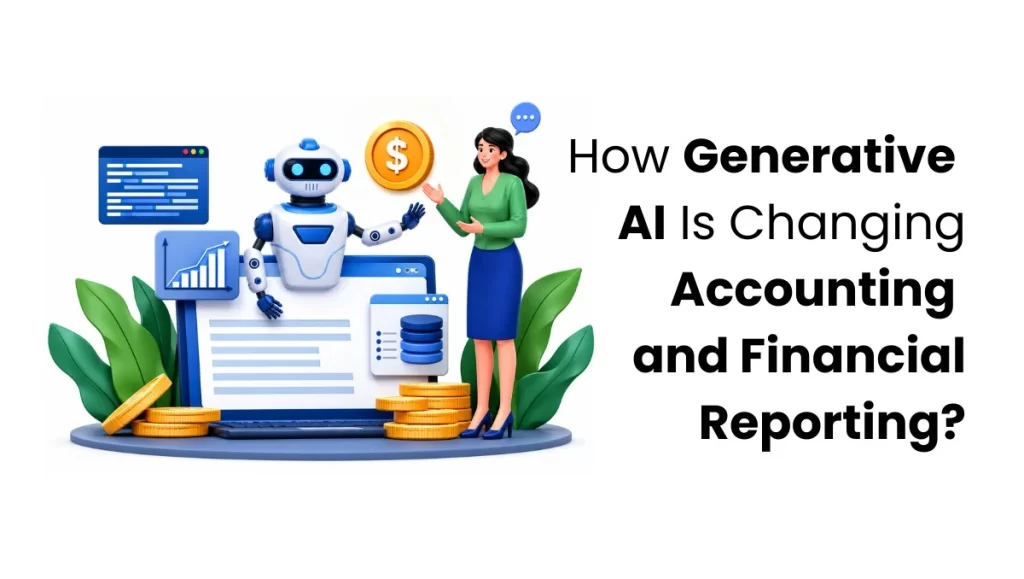
Technology is changing the way businesses work, and the finance and accounting industry is no exception. With the rise of Generative Artificial Intelligence (GenAI), organisations are finding smarter, faster ways to manage financial tasks and reporting processes.
Traditional accounting activities often involve repetitive tasks, such as data entry, report preparation, and analysis of large volumes of financial data. Generative AI performs these tasks by processing data quickly and identifying patterns. Thus, Finance professionals can save time, improve work accuracy, and focus on strategic activities that drive business growth.
But we can’t say that generative AI completely replaces human kno wledge and professional skills. Instead, it acts as a supportive tool that improves efficiency and helps professionals work more effectively. As businesses continue to adopt AI technologies, accounting and financial reporting are entering a new era. Let’s explore how Generative AI is changing accounting and financial reporting.
Generative AI in Accounting
Generative AI is becoming an important tool in modern accounting because it simplifies many financial activities and improves how work is performed. By reducing manual effort and supporting faster decision-making, it is helping businesses become more efficient and productive.
Benefits of Generative AI in Accounting
Let us explore some of the major benefits that Generative AI brings to the accounting field.
Streamlining Routine Tasks and Saving Time
Generative AI automates repetitive accounting tasks like data entry, invoice processing, reconciliation, and transaction recording. This reduces manual workload and allows accountants to focus on analysis, planning, and decision-making. It improves productivity and saves organisations valuable time.
Improving Accuracy and Reducing Errors
Generative AI helps make accounting more accurate by cutting down the need for manual data entry and calculations. Since most of the routine work is automated, there are fewer chances for mistakes. Over time, it also improves its data handling, helping organisations maintain more reliable financial records and stay aligned with accounting standards.
Providing Real-Time Data Analysis and Insights
Generative AI can quickly go through large amounts of financial data in real time. It picks up trends, patterns, and unusual activities that might otherwise go unnoticed. These insights help businesses understand their performance more clearly and make quicker, more informed decisions.
Enhancing Financial Planning and Risk Management
Generative AI helps identify risks and opportunities by analysing financial data. It supports better decision-making, improves budgeting and forecasting, and gives a clearer view of future financial position, helping organisations plan resources more effectively.
Applications of Generative AI in Accounting
Generative AI is now being applied across different accounting functions to improve productivity and overall performance. The following are some important applications of Generative AI in accounting.
Financial Analysis and Forecasting
Generative AI can analyse historical financial information and identify trends, patterns, and relationships within large datasets. By studying previous financial records, businesses can gain valuable insights into their performance and future possibilities. AI can help organisations create more accurate forecasts regarding revenue, expenses, investments, and growth opportunities. Better forecasting helps businesses make informed financial decisions and reduce planning uncertainty.
Tax Preparation and Compliance
Tax preparation can be challenging because accountants must constantly keep up with changing tax rules and regulations. Generative AI makes this easier by quickly adapting to the latest tax laws and requirements. It can suggest potential deductions, help estimate tax liabilities, and handle routine calculations. This reduces the time spent on repetitive work, making the entire process faster. It also helps lower the chances of errors. In addition, AI tools can help accountants answer complex tax-related questions more efficiently.
Financial Reporting and Footnote Preparation
Preparing financial reports is a key part of accounting, and they must be both accurate and consistent. Generative AI makes this process easier by automatically generating financial summaries and reports, including balance sheets, income statements, cash flow statements, and supporting footnotes. It can pull information from different sources, organise it properly, and turn it into clear, well-structured reports. This reduces a lot of manual work, saves time, and helps improve the overall quality and reliability of financial reporting.
Bookkeeping Automation
Bookkeeping involves many repetitive, time-consuming activities, such as entering financial data, processing invoices, recording transactions, and reconciling accounts. Generative AI can automate these routine tasks, reducing the need for continuous manual work. Automation helps minimise human errors and improves overall efficiency. As a result, accountants can focus on strategic activities and business analysis rather than spending time on repetitive administrative duties.
Audit Automation
Auditing requires examining large amounts of financial information to identify risks and ensure accuracy. Generative AI improves auditing processes by quickly processing and analysing large datasets. AI systems can identify unusual patterns, inconsistencies, and discrepancies that may indicate errors or potential risks. This helps auditors complete their work more quickly and enhances the reliability and quality of audit procedures.
Conversational Finance and Virtual Assistants
Generative AI enhances the capabilities of chatbots and virtual assistants by improving their understanding of language, context, and user needs. These systems can answer questions, provide information, and support employees or customers through more natural conversations. AI-powered assistants improve communication, provide quick access to information, and enhance the user experience. They also allow employees to focus more on important tasks rather than spending time searching for information.
Generative AI in Financial Reporting
Financial reporting plays an important role in helping organisations share financial information with investors, managers, regulators, and other stakeholders. Before generative AI, preparing financial reports involved extensive manual work, including data collection, record review, report preparation, and compliance with regulations and standards. With the introduction of Generative Artificial Intelligence (Gen AI), the financial reporting process is becoming faster, more accurate, and more efficient, helping organisations manage financial information more effectively.
Benefits of Generative AI in accounting
Let us explore some of the key benefits of AI in financial reporting.
Predict Trends and Impacts
Generative AI helps organisations understand future financial trends by looking at past data and market conditions. It can more accurately predict revenue, expenses, and cash flow, and also explain the main reasons behind financial changes. It further tests different scenarios, identifies potential risks, and supports better planning and decision-making.
Identify and Manage Risks
It highlights important issues by their severity, helping finance teams act quickly and appropriately. This improves control, strengthens governance, and helps reduce financial reporting risks.
Improve Data Accuracy
AI improves accuracy by reducing manual data entry and errors. It analyses various types of data to provide a comprehensive financial view and detects errors or anomalies in real time. It also speeds up account reconciliation.
Support Data-Driven Decision Making
Gen AI combines data from different sources and delivers clear, easy-to-understand insights. It helps ensure everyone across teams works with the same reliable information and improves overall transparency. This makes it easier for organisations to make quicker and more confident decisions.
Applications of Generative AI in Accounting
Generative AI is changing financial reporting by making it more efficient, accurate, and insight-driven. It helps organisations process financial data quickly and supports better reporting and decision-making. Below are some key applications of Generative AI in financial reporting.
Automation of Financial Processes
Generative AI helps automate many financial reporting tasks that were previously completed manually. Organisations can use AI-powered tools to establish rules and automate repetitive processes in real time. Modern AI systems can integrate with existing financial tools, spreadsheets, and enterprise resource planning (ERP) systems to collect and process data automatically.
This automation minimises repetitive manual work, improves efficiency, and lowers operational costs. Instead of spending time on routine activities, finance professionals can focus on important tasks such as financial planning, strategic decision-making, and business analysis.
Audit Support and Data Quality Management
Auditing is an important part of financial reporting because it helps ensure that financial information is accurate and trustworthy. Traditionally, auditors must review large amounts of financial data and maintain detailed records, which can be a lengthy, difficult process.
Generative AI helps auditors quickly review large volumes of data. It can detect unusual patterns, errors, or suspicious transactions that may be missed by manual review. This improves data quality, reduces audit time, and helps auditors work more accurately.
Compliance and Regulatory Management
Organisations must comply with many financial regulations and legal requirements. Maintaining compliance can be difficult because regulations change frequently and often involve complex requirements. Generative AI can support compliance processes by automatically monitoring regulations and identifying differences or irregularities within financial data.
AI systems, especially those based on large language models, can automate several compliance-related activities and reduce the risk of non-compliance. This helps organisations maintain better control over financial reporting processes while improving overall efficiency.
Data Analysis and Predictive Insights
Data analysis is one of the most valuable applications of Generative AI in financial reporting. Predictive analytics and machine learning technologies allow organisations to analyse large amounts of financial data in real time. AI can perform tasks such as data extraction, validation, pattern recognition, and trend analysis more efficiently than traditional methods.
These systems help organisations identify opportunities and risks early. AI detects unusual patterns before they become major issues, so companies can make proactive decisions and maintain stronger data integrity.
Fraud Detection and Risk Prevention
Fraud prevention is another area where Generative AI helps financial reporting. Organisations face risks from fraud, data breaches, and suspicious activities. AI-powered systems monitor financial data and spot unusual transactions in real time. Machine learning algorithms identify patterns associated with fraudulent activity and warn organisations early when potential risks are detected. This enables organisations to take preventive actions quickly and to strengthen risk management practices.
Conclusion
Generative AI is changing how accounting and financial reporting are done today. It handles repetitive tasks, reduces errors, and helps people get useful financial insights much faster. Whether it’s forecasting, compliance, audits, or fraud detection, it makes financial work easier to manage and much more efficient.
At the same time, it is not replacing accountants. Human judgment is still needed to understand results, make decisions, and use the information correctly. Instead, AI works like a helpful tool that supports professionals and lets them focus more on important work, such as analysis and planning.
If you want to shape your future in finance, enrol in accounting courses in Kochi. Building your expertise in both accounting and technology today will set you apart and help you thrive in a rapidly changing industry.
FAQs
1. What is Generative AI in accounting?
Generative AI in accounting means the use of artificial intelligence tools that can create, analyse, and process financial data. It automates tasks such as data entry, reporting, forecasting, and analysis, enabling accounting work to run faster and more efficiently.
2. How does Generative AI improve financial reporting?
Building on this, Generative AI improves financial reporting by quickly examining large volumes of data and generating reports. It reduces manual effort, minimises errors, and provides real-time insights that help organisations make better financial decisions.
3. Will Generative AI replace accountants?
Generative AI is not replacing accountants. It makes their work easier by automating repetitive tasks. Accountants are still essential for understanding financial results and guiding financial planning and strategy.
4. What are the benefits of using Gen AI in accounting and reporting?
Given AI’s supportive role, the main benefits include improved accuracy, faster processing, better risk detection, real-time insights, and reduced manual workload. It also helps organisations improve efficiency and focus more on strategic financial activities.
5. Is Generative AI useful for tax preparation?
Generative AI helps simplify tax preparation by analysing tax rules, suggesting deductions, and calculating liabilities. It decreases manual errors and speeds up the overall process.