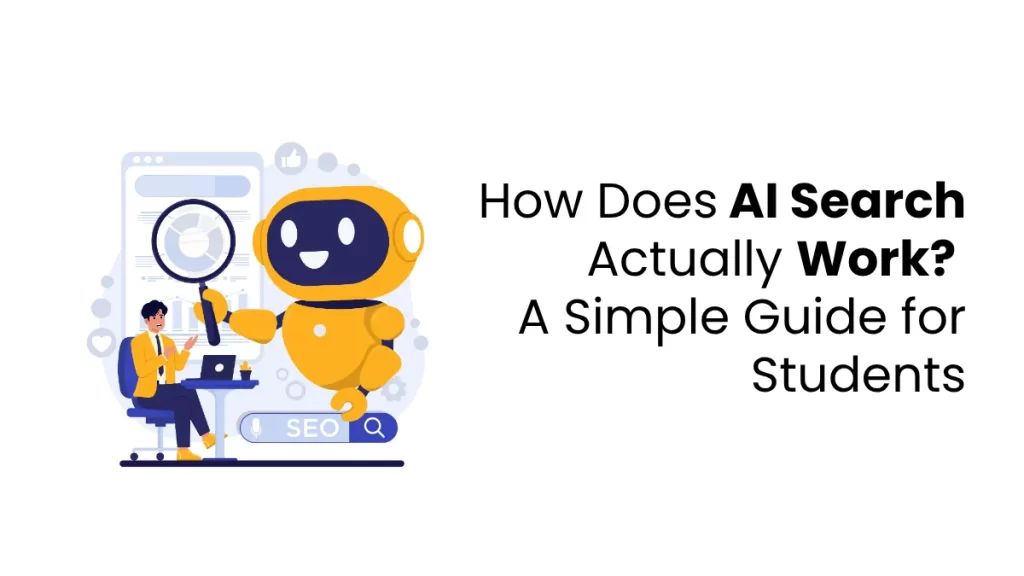
Have you noticed that searching for things online feels different lately? A few years ago, you had to type in specific keywords and click through ten different websites to find a single answer. Now, you can ask a full question, and the search engine just answers you.
Whether you’re using ChatGPT, Google’s AI Overviews, or Perplexity, the way we find information has changed. But how does the brain behind the screen actually figure out what you want? If you are looking into SEO training in Calicut, understanding this change is the first step to becoming a modern digital marketer. Let’s see what this change really means for someone learning SEO.
From Matching Words to Understanding Meaning
Traditional search engines were like librarians who only looked at the titles of books. If you searched for ‘how to get a job with no experience’, the system would just look for websites that had that exact sentence in the title. It was a word-matching game. AI search is different. It uses Semantic Search, which means it focuses on your intent – the ‘why’ behind your search.
For example, if you search: ‘ I’m a student, and I want to start earning money online’, the AI doesn’t just look for those specific words. It interprets your query based on patterns and similar searches. It predicts that you may be interested in options like freelancing, content writing, or digital marketing roles.
Why this matters for a Digital Marketing student
Imagine you’re stuck on a project and search: ‘ how to make my website show up on page one.’
Old Search: Would give you 50 articles titled ‘ How to show up on page one ’.
AI Search: Understand you are asking about SEO strategies, Backlinks, and Keyword Research. It gives you the solution (the technical topics) even if you didn’t know the right names for them yet.
This is why, if you’re looking into an SEO course in Calicut, you’ll learn that you can’t just stuff keywords into a page anymore. You have to write for the student who is looking for a career path, not just a specific phrase. AI is now smart enough to recognize that a blog about ‘career growth’ and ‘digital skills’ is essentially talking about the same goal.
How the AI Reads Your Question
When you type a query, the AI goes through three main steps:
- Breaking it down: It ignores fluff words and identifies the main subjects (called entities).
- Understanding Meaning: The AI converts words into a format it can understand, so it can recognize similar meanings. For example, it knows that “job” and “work” are related, even though they are different words.
- Contextual Clues: It looks at your previous questions or your location to give a more relevant answer. If you’re searching for a digital marketing course, the AI knows you likely want something nearby or a reputable institute with a solid track record.
Creating the Answer (Generative AI)
The most important change is that AI doesn’t just give you a list of links. Since it generates answers directly, there is also a risk of incorrect or incomplete information if the sources are not reliable.
To do this, the AI uses a mix of trained knowledge and, in some cases, retrieved or indexed web data to generate a clear response. This is often referred to as AEO (Answer Engine Optimization), where your content is written in a way that directly answers a user’s question – like what you see in featured snippets or voice search results.
With AI-generated answers becoming common, the conversation is moving toward Generative Engine Optimization (GEO). The difference is simple: AEO is about giving a clear answer, while GEO is about becoming the source that the AI actually trusts and uses while generating that answer.
So it’s not just about answering a question anymore, but about being reliable enough for the AI to pick your content in the first place. This is why clear, direct writing is so important today – If content is not structured clearly, AI may not extract it effectively for summaries.
Why AI Search Needs Human SEO Experts
Many people assume AI tools will replace SEO professionals completely. That assumption is wrong. AI can organize information and generate answers, but businesses still need experts who know how to make their websites visible in those answers. If you are considering search engine optimization coaching in Kozhikode, you’ll quickly learn that ranking today depends on strategy, not stuffing pages with repeated keywords.
Modern SEO now focuses on:
- Solving User Queries: Creating content that directly answers what people are searching for.
- Building Credibility: Showing search engines that your brand is a dependable source.
- Improving Experience: Keeping websites fast, mobile-friendly, and simple to use.
Real-World Impact of AI Search on SEO
To see how AI search is influencing SEO, it’s important to understand how search engines behave today and how they present answers.
Zero-Click Searches and Their Impact on SEO
With features like Google AI Overviews, the search engine now generates a summary at the top of the page using multiple sources. This has led to a major change called Zero-Click Searches – where a user gets their answer directly on the results page without ever visiting a website.
For a digital marketer, this creates a balance: you might lose a ‘click,’ but if your content is the one the AI uses to build that summary, you build strong brand authority and trust.
For example, if someone searches ‘what is digital marketing’, the answer may already appear at the top – no click required.
Practical SEO Changes for Modern Content
Because of AI search and zero-click behavior, SEO is no longer just about ranking. It’s about being selected as a source for direct answers.
1. Structured Data
Schema markup helps search engines to understand the meaning of your content more clearly. It can improve visibility in rich results, answer boxes, and AI-generated summaries.
2. Featured Snippets
Short, well-organized answers often appear at the top of search results. Using clear headings, bullet points, and direct explanations can improve your chances of being featured.
3. EEAT (Experience, Expertise, Authoritativeness, Trustworthiness)
Search engines prefer content that reflects strong quality standards, such as:
- Experience: Insights gained from real-world practice
- Expertise: Strong subject knowledge
- Authoritativeness Reputation within the niche
- Trustworthiness: Accurate and dependable information
The first “E” – Experience – matters more now. Because today, anyone can generate content using AI, but not all of it feels real. Content that comes from actual learning or doing something tends to stand out more.
Conclusion
AI search isn’t about matching keywords anymore; it’s about understanding the intent behind a query. It predicts what the user is actually looking for and prioritizes content that answers it clearly. If your content is vague, generic, or poorly structured, it simply won’t be used.
For students who want to build a career in digital marketing, understanding these search changes is really important. At Finprov Learning, we focus on practical methods that reflect how search engines work today. Our SEO training helps learners create content that performs well for both users and AI-powered platforms. As technology advances, the ability to communicate useful information clearly will remain valuable.
FAQs
What is the difference between traditional search and AI search?
Traditional search involves looking for keywords and matching them with website titles, while AI search involves understanding the intent of the question being asked. Instead of being provided with a list of links, AI search uses information from various sources to give you a direct and conversational answer to your question.
How does AI search affect SEO for businesses?
AI search has changed SEO priorities. Instead of relying on repeated keywords, businesses now need useful content, clear structure, and strong credibility. Search systems are more likely to highlight pages that answer questions effectively and offer real value. That is why modern SEO training in Calicut focuses on content quality and search intent.
What is AEO (Answer Engine Optimization)?
AEO refers to optimizing content so search engines can use it for direct answers, featured snippets, and voice search responses. As AI-generated summaries become more common, this has expanded into GEO (Generative Engine Optimization), which focuses on making your content reliable enough to be selected and cited inside AI-generated answers.
Is Keyword Research Still Important for SEO with AI?
Yes, keyword research is still important, but the focus is now on concepts or user intent instead of specific keywords. Current search engines look for synonyms and related keywords (semantic keywords) to ensure that the content is actually useful to readers.
Why is my website not showing up in AI summaries?
There are several reasons why your website might not be included in AI summaries. Your content could be too vague, poorly structured, or missing clear answers to common user questions. AI answer engines favor websites that provide high-quality information in simple, easy-to-understand terms.