Introduction
Data plays a significant role in how businesses operate today. From customer information to daily transactions, businesses collect a lot of information. But just collecting data is not enough. Businesses should understand that data and use it to make better decisions. This is where data analytics and data intelligence help. Although these terms are often used together, they are not the same, and understanding the difference between them is essential for making better business decisions.
Data analytics helps businesses examine data to find useful insights and solve specific problems. It can be used to reduce customer churn, detect fraud, and improve products or services. By analyzing past and present data, companies can understand what is working and what needs improvement.
Data intelligence goes a step further. It combines data management, data mining, machine learning, and human input to provide a broader view. It helps organizations make smarter decisions for the future and improve overall performance. It is also widely used across healthcare, finance, and e-commerce.
Many businesses face challenges such as poor data governance, limited resources, and insufficient data control. Using both data analytics and data intelligence together can help overcome these issues. In this blog, we will explore the differences between them and how they help businesses make better use of data.
What is Data Intelligence?
Data intelligence is an approach that ensures an organization’s data is accurate, up to date, and easy to access. It also includes the tools, technologies, and skills needed to turn that data into actions and decisions. Companies that aim to be data-driven invest in strong data intelligence practices, including both skilled professionals and advanced systems.
Data intelligence covers the entire data lifecycle, from collecting and organizing data to storing, managing, and preparing it for analysis. Teams use technologies like data warehouses, data lakes, ETL tools, APIs, and data governance systems to ensure data quality, security, and compliance.
Data intelligence also supports analytics, business intelligence, and AI by providing clean and reliable data. It helps generate reports, dashboards, and predictions that businesses can trust. In modern systems, automation plays a key role in efficiently managing large volumes of data.
Moreover, data intelligence helps organizations make sense of their data and use it confidently. It lays a strong foundation for accurate insights, better decision-making, and smarter use of technologies such as AI and machine learning.
Data Analytics
Data analytics is the process of collecting and examining data to find useful insights that help businesses understand their operations and guide future actions.
Data analytics is about analyzing data to uncover patterns, trends, and connections. This can be done using various tools and techniques, sometimes in real time, to achieve quick, accurate results. Today, even non-technical users can explore data using simple tools with features like natural language queries and automated insights.
Data analytics is used to make better decisions. For example, a company might analyze sales data to understand which products are performing well, or a hospital might study inventory data to manage medical supplies more effectively. It helps organizations plan ahead by predicting future trends and suggesting the best actions.
We use data analytics in daily life too, often without realizing it. Checking the weather before going out, tracking steps on a fitness app, or even measuring ingredients while cooking are all simple examples of using data to make decisions.
Overall, data analytics enables businesses and individuals to make informed decisions. It enables organizations to become more confident, proactive, and better prepared for the future by using data in a smart, practical way.
Difference between Data Intelligence and Data Analytics
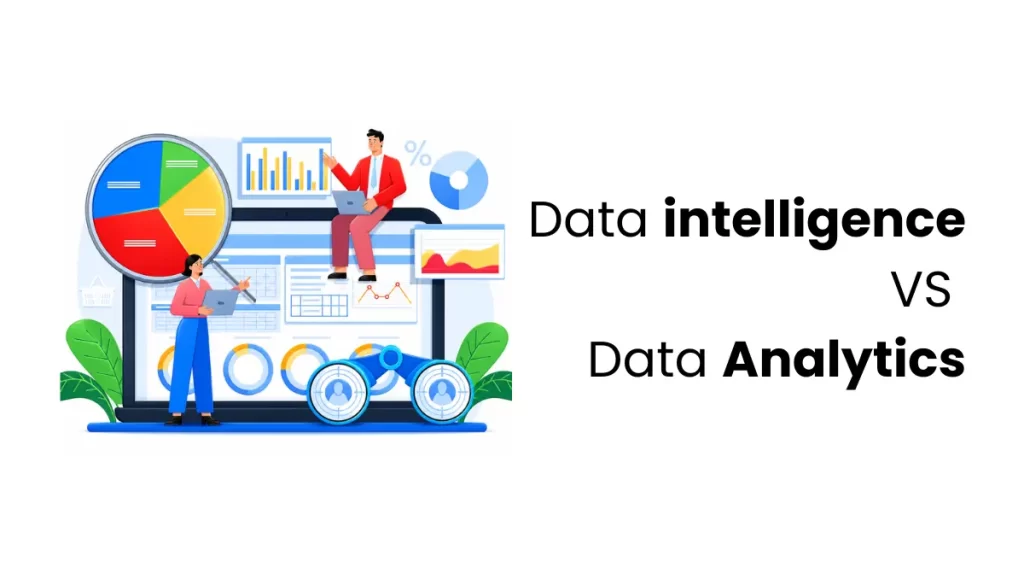
Data intelligence and data analytics are closely related but not the same.
Data intelligence is about preparing and understanding data. It focuses on collecting, organizing, cleaning, and managing data to ensure it is accurate, reliable, and easy to use. It also looks at past data to understand what happened and why. The goal is to make data meaningful for decision-makers.
Data analytics, on the other hand, is about using that prepared data to find insights and make decisions. It focuses on analyzing data to identify patterns, predict future outcomes, and suggest actions.
In simple terms, data intelligence lays the foundation, while data analytics uses it to generate results.
For example, imagine a company launching a product. Data intelligence helps gather all the data, such as sales numbers, customer feedback, and campaign performance, and organizes it to understand what worked and what didn’t. Data analytics then uses this information, along with current market trends, to predict future sales and determine which strategies to pursue next.
Another way to look at it is this: data intelligence answers questions like what happened and why, while data analytics answers what will happen next and what should be done.
Both are important. Without data intelligence, the data may not be reliable. Without data analytics, the data cannot be fully used for decision-making. Together, they help businesses make smarter, faster, and more confident decisions. Learning both concepts through a data analytics course can help individuals build strong data skills.
Use Cases of Data Analytics and Data Intelligence
Data analytics and data intelligence are used across many industries to solve various problems and improve decision-making. While data analytics focuses on analyzing data to find insights, data intelligence uses those insights to guide smarter actions and long-term strategies. The following use cases show how both are applied in real-world business areas.
| Industry | Data Analytics Use Cases | Data Intelligence Use Cases |
| Marketing / Sales | Understand customer behavior and preferences to improve campaigns and offer better products. | Analyze customer data to target the right audience and improve overall marketing performance |
| Healthcare | Study patient data to identify health risks and improve treatment | Understand patient data in depth and predict future health issues for better care |
| Finance | Track market trends and patterns to support smarter investment decisions | Analyze performance and risks to make safer financial and operational decisions |
| E-Commerce | Understand customer needs, manage inventory, and set pricing to increase sales | Analyze customer preferences, manage stock, and optimize pricing for better business decisions |
| Customer Service | Analyze customer interactions to identify issues and improve support quality | Use customer data like feedback and purchase history to improve experience and satisfaction |
| HR | Analyze employee data to track performance and identify trends | Use workforce data to improve hiring, employee engagement, and overall management |
| Education | Track student progress and identify areas needing improvement | Analyze student data to personalize learning and improve outcomes |
| Supply Chain | Analyze logistics data to improve delivery speed and reduce costs | Use real-time data to manage supply chain operations smoothly and avoid disruptions |
| Transportation | Plan efficient routes and schedules to reduce costs and improve efficiency | Track orders, deliveries, and operations to reduce delays and improve workflow |
Conclusion
Data is everywhere, but its real value comes from how well it is used. Data intelligence and data analytics together help businesses turn raw data into meaningful actions.
Data intelligence focuses on organizing and managing data so it is clean, reliable, and easy to use. Data analytics then uses that data to uncover insights, understand trends, and predict the future.
When used together, they help businesses work better, make smarter decisions, and stay competitive. Thus, businesses can make decisions based on reliable, high-quality data.
In the end, data intelligence gives direction to data, and data analytics gives it purpose. Together, they help businesses grow with confidence and make smarter choices every day.
FAQs
What is the main difference between data intelligence and data analytics?
Data intelligence means preparing data for accuracy. Data analytics is the process of analyzing data to find answers.
Why are data intelligence and data analytics important for businesses?
They help businesses understand their data, make better decisions, improve performance, and reduce risk by using accurate information rather than guesswork.
Can a business use data analytics without data intelligence?
It is possible, but not effective. Without proper data management, data may be inaccurate or incomplete, resulting in poor results.
How does data intelligence support AI and machine learning?
It provides clean, structured, and reliable data, which helps AI and machine learning models produce accurate and useful results.
How does data intelligence support business growth?
It ensures businesses have reliable data, which helps in making better strategies and decisions.