Search results are changing faster than ever, and Google no longer works the way it used to. Instead of just a list of blue links, you often see a summary at the very top that answers your question directly. One of the technologies behind these AI-generated answers is RAG.
For anyone interested in a digital marketing career, understanding RAG is no longer optional. It is one of the key technologies behind how modern search engines understand information and generate answers. In this guide, we will explain what RAG is, how it works, and how you can use it to grow your website traffic.
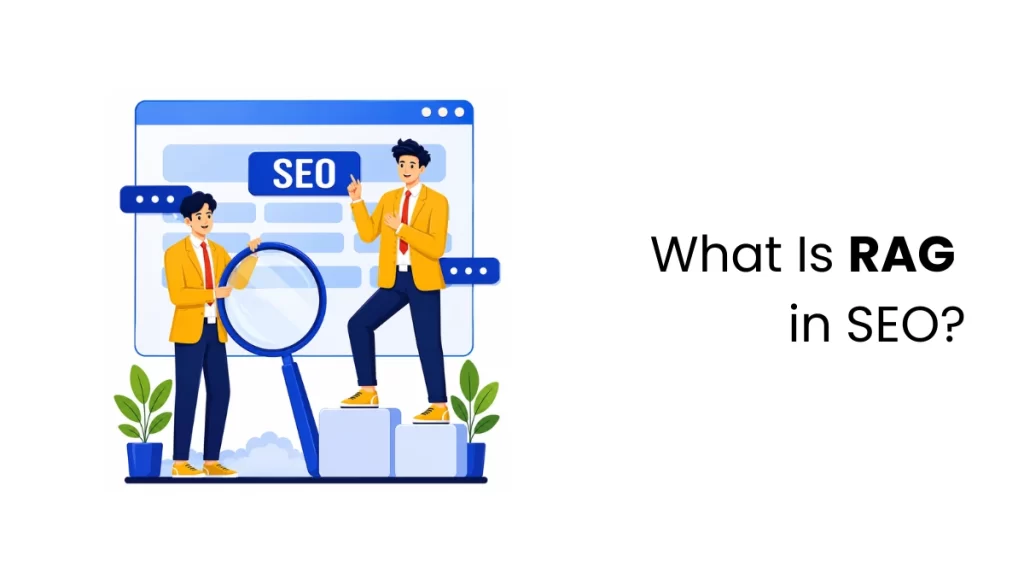
What exactly is RAG in SEO?
RAG stands for Retrieval-Augmented Generation. To understand this clearly, let’s look at each word:
Retrieval: This means the AI goes out and finds information from the internet.
Augmented: The AI combines the new information it finds with what it already knows.
Generation: This is when the AI writes a fresh answer for the user based on those facts.
In simple terms, RAG is a way for an AI to stay updated. Without RAG, an AI only knows what it was taught during its training. With RAG, the AI can read your latest blog post today and use that information to answer a user’s question five minutes later.
Why Is RAG Important for SEO?
In the past, SEO was mostly about matching keywords. If a user searched for ‘best phone under 20,000’, Google would look for pages that repeated that phrase.
Today, Google uses RAG to understand the intent and the facts. Here is why this matters for your website:
1. The Rise of Answer Engines
Search engines are becoming Answer Engines. Users don’t want to click five different websites to find one piece of information. They want the answer immediately. RAG allows Google to pull the best answer from your site and show it directly on the search page.
2. High Accuracy
Standard AI models sometimes hallucinate, which means they make up facts that aren’t true. RAG stops this by forcing the AI to look at real, published websites before it speaks. For SEO, this means that being a trusted, factual source is more important than ever.
3. Citations and Links
When an AI uses RAG to answer a question, it usually provides a link to the source. If your website is the source, you get the traffic. This is a new way to get visitors without them ever clicking a traditional search result.
How Does RAG Work?
If you are studying for a digital marketing training in Kochi, you need to know the technical flow of how search results are built now.
The Query: A user types a question into Google.
The Search: The system searches its index for the most relevant pages (this is the Retrieval part).
The Context: The system takes the top snippets from those pages and gives them to the AI model.
The Answer: The AI reads those snippets and writes a summary that answers the user’s specific question (this is the Generation part).
How to Prepare Your Content for RAG?
You cannot force an AI to choose your website, but you can make your website very easy for the AI to understand. Here are four practical steps:
Use the Inverted Pyramid Style
Start your blog posts with a direct answer to the main question. Don’t hide the information in the middle of a long paragraph. If the AI finds the answer in the first few sentences, it is more likely to use your site as the source.
Focus on Entities and Facts
Instead of using vague language, use specific names, dates, and data. AI models look for entities (people, places, things) to confirm that your content is valuable. For example, instead of saying ‘Our course is very good,’ say ‘Our course covers 12 modules including SEO, SEM, and SMM.’
Use Clear Table and Lists
AI loves structured data. If you are comparing two things, use a table. If you are listing steps, use bullet points. This makes the Retrieval part of RAG much faster and more accurate.
Update Your Content Often
Since RAG looks for the most recent information, an old blog post from 2022 might be ignored. Regularly updating your facts and figures ensures that the AI sees your content as fresh.
LLM vs. RAG: A Simple Comparison
| Feature | Standard AI (LLM) | RAG-Powered Search |
| Information Source | Only its training data | Live internet data |
| Timing | Often outdated | Real-time / Latest info |
| Trust Level | Moderate (can hallucinate / give incorrect info) | Higher (uses verified sources/sites) |
| SEO Impact | Low | Very High |
The Future of Search Experience Optimization (SXO)
We are moving away from simple SEO to something called SXO (Search Experience Optimization). This means your goal is to provide a great experience for both the human reader and the AI bot.
A human wants a page that loads fast and is easy to read. An AI wants a page that is factual and well-structured. If you satisfy both, you will win the top spot in the search results. This is exactly the kind of advanced strategy that is taught in a professional digital marketing training in Kochi.
Conclusion
RAG is one of the technologies changing how search engines understand and answer questions. It helps AI systems use real-time information to generate more accurate and reliable responses. As a content writer or marketer, your job is to provide the textbook that the AI wants to read.
By focusing on direct answers, clear structures, and factual data, you can stay ahead of the competition. If you want to learn how to implement these strategies for real-world businesses, you can find expert guidance at Finprov Learning. Mastering these tools today will ensure your career in digital marketing remains strong as the technology continues to change.
FAQs
1. What is the difference between RAG and traditional SEO?
Traditional SEO focuses on ranking a website in a list of links based on keywords and backlinks. RAG SEO focuses on making your content the primary source that an AI reads to generate a direct answer. While traditional SEO targets clicks, RAG SEO targets citations within AI-generated summaries.
2. How does Retrieval-Augmented Generation improve search accuracy?
RAG improves search accuracy by connecting an AI model to a live, trusted database (like the web) instead of relying on its old training data. This process, known as ‘grounding’, ensures the AI provides up-to-date facts and reduces hallucinations or false information.
3. Does RAG SEO help with Google’s AI Overviews?
Yes. Google’s AI Overviews use RAG technology to summarize the best information from the web. By optimizing your content for RAG – using clear structures, factual data, and direct answers – you increase the chance that Google will cite your website as the main source for its AI summary.
4. What are the best ways to optimize content for RAG?
To optimize for RAG, you should:
Use direct language: Answer the main question in the first 50 words.
Structure with Schema: Use FAQ and Article schema markup to help AI parse your data.
Focus on facts: Include specific data, statistics, and expert insights.
Update regularly: AI models prefer fresh data over outdated posts.
5. Is RAG the same as Answer Engine Optimization (AEO)?
RAG is the technology that search engines use, while AEO is the strategy that marketers use to optimize for it. AEO involves formatting your content so that RAG-based systems like ChatGPT or Gemini can easily extract and present your information as the definitive answer.