Imagine being familiar with the diverse laws related to taxation, efficiently handling GST-related features with updates, and constantly updating your knowledge. What if you lack the capability to handle these tasks, or what if you possess these abilities? Let’s discuss another point. Are you familiar with E-invoicing under GST? Do you know what e-invoicing is and how it is applicable under GST? Being well-versed in these concepts can bring you significant career exposure. E-invoicing under GST can be defined as electronic invoicing in accordance with GST laws.
E-Invoicing Under GST
Let’s get the idea in detail. Most clearly, it can be referred to that the e-invoice can be addressed as a system introduced by the Indian Government, which eases the GST return filing process. It involves the generation of invoices on a central government portal called the Invoice Registration Portal (IRP), which then gets authenticated and verified. This process helps to reduce errors and mismatches, making it easier for several businesses to file GST returns correctly.
Generally, as in the case of a GST, the registered business generates an e-way bill during the transportation of goods and services from one place to another. Like the wise, certain GST-registered businesses can generate e-invoices for Business to Business (B2B) transactions. In more detail, the e-invoice system can be defined as a B2B invoice that is authenticated by Goods and Services Tax Network(GSTN) for continued use on the common GST portal. The electronic invoicing system issues a unique identification number against every invoice through the Invoice Registration Portal (IRP), which is managed by GSTN. The process ensures authenticity as well as accuracy while filing GST returns and simplifies invoice processing.
The most considerable aspect of e-invoice is that all the invoice information is transferred from the einvoice1.gst.gov.in portal to both the GST portal and e-way bill in real-time. Thus, E-invoicing eliminates the need for manual data entry while filing the GSTR-1 return (GSTR-1 is a type of GST return that needs to be filed by registered taxpayers in India who are all involved in the supply of goods or services) and generating part-A of the e-way bills. The IRP automatically passes the required information to the GST portal, which reduces errors and saves time for businesses. This simplifies the invoicing process, which will enable businesses to file their GST returns accurately and efficiently.
In September 2016, the GST Council was established. Its 35th meeting is very relevant during a discussion on e-invoice. The 35th meeting decided to implement the GST Council’s decision to implement a system of e-invoicing, covering specific categories of persons, mostly large enterprises. Gradually, the implementation will also be covered by even medium-sized enterprises as well as small-scale businesses. E-invoicing does not refer to the creation of invoices within the GST portal; rather, it involves the act of uploading a pre-generated standard invoice onto an e-invoice portal.
As per notification no. 69/2019- The Central Board of Indirect Taxes and Customs(CBIC), in India, has notified a set of common portals to enable e-invoice preparation. The system pointed out that business firms can submit the invoice details once, and automation is enabled, which means the details will be automatically used for various reporting requirements. The use of e-invoicing portals helps businesses automate their reporting process and avoid errors in manual data entry.
Applicability of E-Invoice
As per the latest GST regulations applicable in 2026, e-invoicing is mandatory for businesses whose Aggregate Annual Turnover (AATO) exceeds INR 5 crores in any financial year from FY 2017-18 onwards.
Such businesses are required to generate e-invoices for:
- Business-to-Business (B2B) transactions
- Export transactions
- Supplies made to Special Economic Zones (SEZs)
- Debit notes and credit notes related to applicable invoices
However, certain categories, such as banks, insurance companies, NBFCs, Goods Transport Agencies (GTAs), passenger transportation services, and SEZ units, are exempt from e-invoicing as notified by the government. E-invoicing improves GST compliance, reduces fake invoicing practices, minimizes reporting errors, and ensures the smooth flow of Input Tax Credit (ITC) across the GST system.
Understanding the Benefits of E-Invoicing under GST
E-invoicing under GST has become a crucial aspect of tax compliance for businesses in India. Let’s explore the benefits of implementing e-invoicing in your business processes.
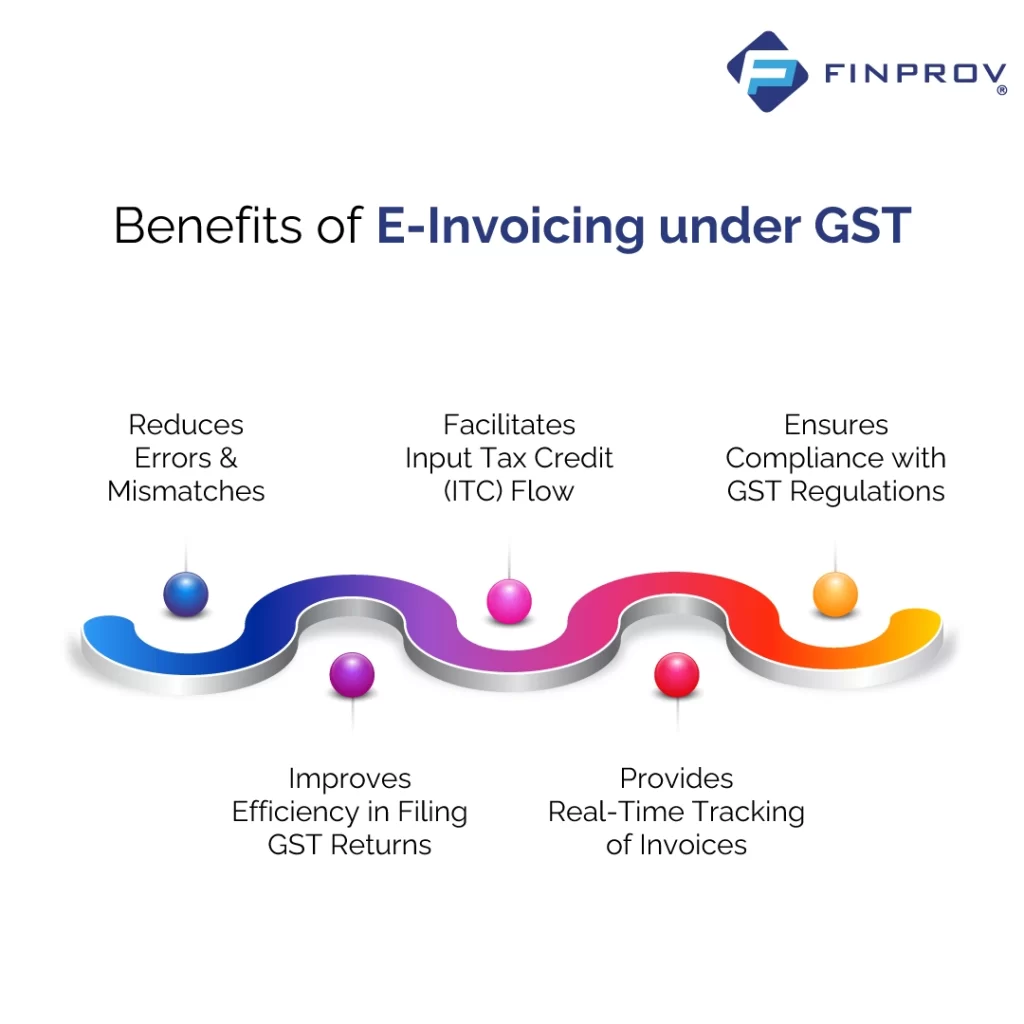
Reduces Errors and Mismatches
One of the significant benefits of e-invoicing is the reduction of errors and mismatches. Manual data entry is a tedious process, and there is a high chance of errors. With e-invoicing, the data can be directly uploaded to the central government portal, thereby reducing the chances of errors.
Improves Efficiency in Filing GST Returns
E-invoicing has made the process of filing GST returns more efficient. The invoicing process is simplified, which enables GST Return filing more easily.
Facilitates Input Tax Credit (ITC) Flow
The input tax credit is a critical aspect of the GST system. E-invoicing facilitates the smooth flow of ITC across the GST system. With e-invoicing, it is easier for businesses to claim ITC.
Provides Real-Time Tracking of Invoices
E-invoicing provides real-time tracking of invoices. The unique identification number generated by the IRP lets businesses track the status of their invoices in real time. This helps businesses to effectively manage their cash flows and improve their overall financial management.
Ensures Compliance with GST Regulations
E-invoicing ensures compliance with GST regulations. The implementation of e-invoicing is mandatory for businesses having a turnover exceeding INR 50 crores. By complying with GST regulations, businesses can avoid penalties and legal hassles.
It is not only E-invoicing under GST, as there are multiple legal regulations and updates related to taxation systems and accounting practices. Keeping oneself up-to-date with these regulations can have a positive impact on one’s career, particularly for those aspiring to work in accounting, taxation, finance, and related fields. It is relevant to continuously update one’s skills and knowledge to stay relevant and updated in the industry.
If you are a job seeker or have a deep enthusiasm for starting a career in the accounting, taxation, or finance industry, Finprov provides an excellent opportunity to elevate your knowledge and skills. At Finprov, you can gain in-depth knowledge about income tax, GST, Gulf VAT, and accounting software such as SAP FICO, Tally Prime, MS Excel, etc. With a comprehensive study pattern and expert faculty, Finprov helps aspirants improve their career prospects.
FAQs
1. What is E-Invoicing under GST?
E-Invoicing under GST is an electronic invoicing system where invoice details are uploaded and authenticated through the Invoice Registration Portal (IRP) under GST regulations.
2. Why was E-Invoicing under GST introduced?
E-Invoicing under GST was introduced to simplify GST return filing, reduce manual errors, improve transparency, and ensure better compliance in invoicing processes.
3. Who should generate E-Invoices under GST?
Businesses whose Aggregate Annual Turnover exceeds INR 5 crores are required to generate e-invoices for B2B transactions, exports, and certain other notified supplies.
4. What are the benefits of E-Invoicing under GST?
E-Invoicing helps reduce data entry errors, improves GST return filing efficiency, enables real-time invoice tracking, and supports smooth input tax credit flow.
5. How can Finprov help in learning E-Invoicing under GST?
Finprov Learning provides practical training in GST, taxation, and e-invoicing concepts to help learners understand real-time compliance procedures and industry practices.