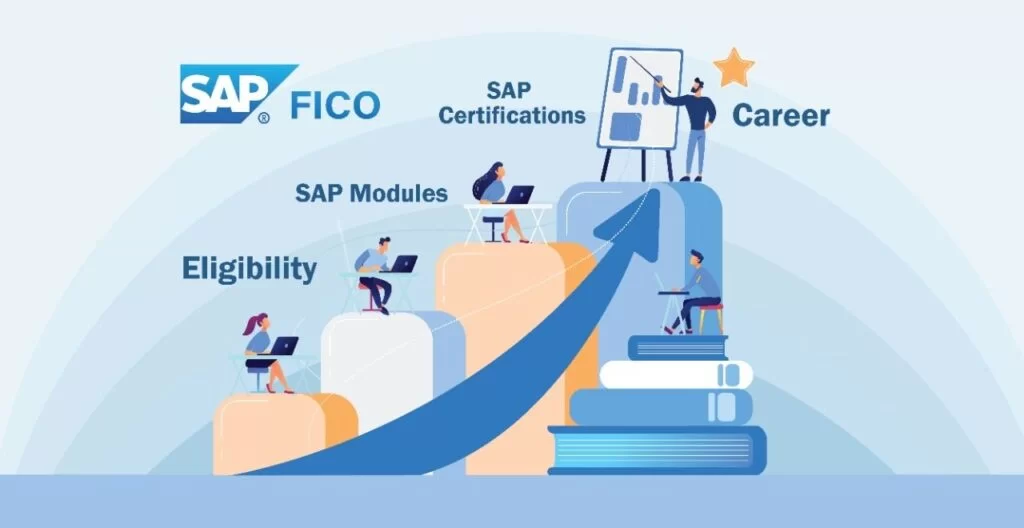
Are you planning to pursue any SAP certifications? Do you have a clear plan about which SAP certificate to take? Are you confused about how to get started? Do you know the eligibility criteria for SAP certification courses? Do you know the minimum qualification for SAP?
With a massive uproar in recent times, SAP certification courses are becoming one of the hottest career-update courses available. SAP has a huge customer base worldwide. This increases job opportunities and openings.
Liked mostly by tech companies, SAP primarily offers Enterprise Resource Planning (ERP) software. They also offer analytics and resource management software.
Although they offer various products, their primary focus and reputation are based on ERP software. Let’s start with the company and SAP ERP software.
What is SAP?
Systems, Applications & Products in Data Processing commonly known as SAP is a German software company known for its renowned ERP software SAP. So, the company name and the ERP software name are the same. This article from now refers to the ERP Software as SAP.
SAP sets a standard of itself when it comes to ERP software. They are available in 37 languages in more than 40 localisations offering in more than twenty-five industries. They have a huge customer base and all these elements together increase the demand for different SAP professionals.
Why is SAP so Popular?
You may be asking why SAP is so popular with companies. The main reason is that it is ERP software. It lets you integrate all departmental functions into a single system and access them anywhere in the world. Second, it makes operations such as resource management, sales, customer relationships, and inventory management easier with minimal investment.
The software integrates smoothly with applications, systems, and products, making it more user-friendly for organisations. Naturally, when a product is efficient, easy to use, and cost-effective, companies will be attracted to it.
SAP Modules for B.Com Graduates
SAP offers different modules that help businesses manage their financial, operational and business processes. For B.Com graduates, SAP FICO and SAP MM are two relevant options to consider based on their career interests.
SAP FICO – SAP Finance and Controlling
SAP FICO is a popular choice for B.Com graduates because it closely relates to accounting and finance. The module helps businesses manage financial transactions, accounting processes and financial reporting. Finprov’s SAP FICO course covers SAP S/4HANA FI, General Ledger Accounting, Accounts Payable, Accounts Receivable, Bank Accounting and Asset Accounting. It also includes practical training in financial transactions, reporting and SAP system operations.
Key topics covered in SAP FICO include:
- Introduction to ERP and SAP
- Enterprise Structure
- General Ledger Accounting
- Accounts Payable
- Accounts Receivable
- Bank Accounting
- Asset Accounting
- Multicurrency
- Basic configuration settings
- Financial reporting
Course Duration: 2 Months
Career Opportunities: SAP FI Consultant, Finance Analyst, Accounts Payable/Receivable Specialist, SAP End User, Financial Controller and ERP Consultant.
SAP MM – SAP Materials Management
SAP MM is another option for B.Com graduates interested in procurement, inventory, materials, and supply chain processes. It helps organisations manage purchasing, materials, inventory and related business operations. Finprov’s SAP MM course covers procurement processes, vendor management, material master data, inventory management, invoice verification, material planning and SAP MM reporting.
Key topics covered in SAP MM include:
- Introduction to SAP MM
- Materials Management
- Procurement Process
- Purchase Requisitions and Purchase Orders
- Vendor Management
- Material Master Data
- Inventory Management
- Invoice Verification
- Material Requirement Planning
- Logistics Execution and Integration
- Reporting and Analysis in SAP MM
Course Duration: 2 Months
Career Opportunities: SAP MM Consultant, Procurement Manager, Supply Chain Analyst, Inventory Manager, Warehouse Manager, Material Planner and SAP End User.
Which SAP Module Should B.Com Graduates Choose?
The right SAP module depends on your career interests. If you’re strongly interested in accounting and finance, SAP FICO may be a good fit. If you are more interested in procurement, inventory management, materials or supply chain operations, SAP MM may be a better fit. Both modules can help B.Com graduates develop practical SAP skills and explore different career opportunities.
SAP Certification
Learners can choose between SAP FICO and SAP MM based on their career interests. Finprov’s programs combine subject knowledge with practical learning to help students become familiar with SAP processes and workplace applications.
A Finprov SAP certification can add value to your professional profile by demonstrating that you have completed structured training in your chosen SAP module. It can be particularly useful for fresh graduates who want to add an industry-relevant skill to their B.Com qualification.
For professionals and graduates, certification can help demonstrate SAP knowledge to potential employers. However, combine certification with practical knowledge and an understanding of real business processes to build a strong career profile.
As SAP regularly updates its products and certification programs, always check the latest certification details and examination requirements before registering.
Conclusion
You do not need a highly advanced qualification to start learning SAP. For many SAP modules, your educational background, work experience, and career goals are more important when choosing the right course. B.Com graduates, in particular, can consider modules such as SAP FICO and SAP MM based on their interests.
If you are interested in accounting and finance, SAP FICO can help you build on your existing knowledge. If you’re interested in procurement, inventory, or supply chain, SAP MM can be another suitable option.
An SAP certification can add an industry-relevant skill to your profile, but certification alone does not guarantee a job. Practical knowledge, an understanding of business processes, and hands-on SAP experience can strengthen your profile.
Before choosing an SAP certification, take some time to understand the module, check the latest eligibility and exam requirements, and pick a course that fits your career goals.
Frequently Asked Questions
Can I learn SAP after B.Com?
B.Com graduates can learn SAP and choose a module based on their interests. SAP FICO is a good option if you want to work in accounting or finance, while SAP MM may suit you if you are interested in procurement, inventory, or supply chain.
Which SAP course is good for a B.Com graduate?
SAP FICO is one of the most relevant choices for B.Com graduates because it builds on what you already know about accounting and finance. If you are more interested in procurement and inventory, you can also consider SAP MM.
Can a fresher get started with SAP?
Yes. You do not need years of work experience to start learning SAP. Fresh graduates can take up SAP training to develop practical knowledge and add an industry-relevant skill to their resume.
Is SAP difficult for beginners?
SAP may look complicated when you first come across it, but it becomes easier once you understand how different business processes work. Good training, hands-on practice, and regular learning can make the process much easier.
Do I need a technical background to learn SAP?
No. You don’t need a technical background. Many SAP modules are closely connected to business functions, so students and professionals from commerce, finance, and other backgrounds can learn them.