
PG Diploma in Indian and Foreign Accounting (PGDIFA)
Launch your dream career in 8 months
Enhance your skills with our PGDIFA course. Learn to manage financial accounting, analyze reports, and navigate key financial processes to advance your career in the accounting and finance industry. Students enrolled in the PG Diploma in Indian and Foreign Accounting (PGDIFA) program learn advanced accounting techniques for domestic and international companies. This diploma in Indian and foreign accounting course has the potential to lead to high salary packages and international work prospects. Since this is a job-oriented course, students will benefit from placement assistance and several internship opportunities.

- Placements
- 90%
Introduction to PG Diploma in Indian and Foreign Accounting Course(PGDIFA)
Course Snapshot
Finprov’s nine-month diploma in Indian and foreign accounting (PGDIFA) course provides students with the fundamental knowledge and abilities required for positions in accounting and finance. This course is your gateway to mastering financial expertise and unlocking global career opportunities. There would be personalized mentorship sessions throughout the course. Students can also solve doubts with expert mentors. The course covers worldwide accounting standards, payroll, TDS, and GST.

What does this course have to offer?
PGDIFA will help you improve your accounting skills by teaching you how to manage invoices and expenses more efficiently.
Our curriculum covers in-demand industry relevant topics
- Financial Accounting
- Cost Accounting
- Taxation
- Invoice Management
- Expense Monitoring
- Auditing Principles
- Financial Reporting
- Budgeting and Forecasting
- Banking and Financial Services
PGDIFA will help you improve your accounting skills by teaching you how to manage invoices and expenses more efficiently.
Our curriculum covers in-demand industry relevant topics
- Financial Accounting
- Cost Accounting
- Taxation
- Invoice Management
- Expense Monitoring
- Auditing Principles
- Financial Reporting
- Budgeting and Forecasting
- Banking and Financial Services
PGDIFA provides superior financial management skills, allowing you to track bills, costs, and financial records accurately for better decision-making.
- Small and Medium Business Owners
- Accountants and Bookkeepers
- Finance Managers
- Career Changers
- Freelancers and Consultants
- Entrepreneurs
- Startups
- Non-profit Organizations
The PGDIFA program provides the necessary industry skills to prepare for various positions in accounting, finance, payroll management, and taxation.
- Financial Analyst
- Payroll Specialist
- Tax Consultant
- Finance Manager
- Accounts Receivable/Payable Specialist
- Billing Specialist
- Budget Analyst
- Auditor
- Cost Accountant
Students must have completed any degree from a recognized university to enroll in this course.
Tools Covered





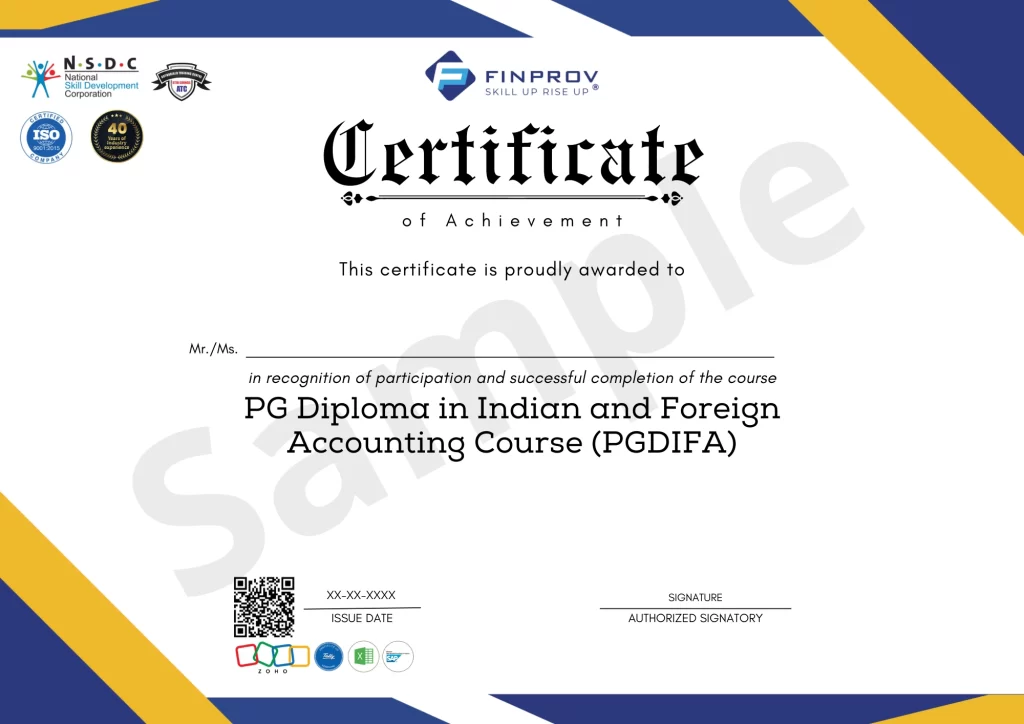
Certificate
Earn Valuable Credentials And Recognition
Make your resume stand out with an Advanced Certification in Indian and foreign accounting and boost your accounting career.
Master PGDIFA with A World-Class Curriculum
Learn PGDIFA with expert guidance, build practical skills, and confidently advance your career. Gain hands-on experience and master data-driven decision-making.
18 modules. Open one to see its topics.
- Practical Accounting - Introduction
- Accounting Terms
- Accounting Cycle
- Source Documents
- Journal Entry & Ledger Accounts
- Trial Balance & Adjustments
- Financial Statements
- Tax Accounting
- Bank Reconciliation
- Company Creation, Alteration & Deletion
- Vouchers
- Point of Sale (POS)
- Cost Category & Cost center
- TDS & GST
- Manufacturing & BOM
- Multi-Currency
- Job Costing & Payroll
- Cheque Register & Bank Reconciliation
- Branch Accounting
- Case Study
- Basics of GST
- Supply
- Place of Supply & Value of supply
- ITC
- Credit note and Debit note
- Invoicing
- Composition
- QRMP Scheme
- E-way bill & E-invoicing
- GST Returns
- Advanced GST and practicals with simulation software
- Introduction to IT
- Assessee & Types of Assessee
- Persons & Tax Rates
- Significance & Applicability of TDS
- No deduction or short deduction of TDS & Due date of TDS payments & returns
- Form 26, 16 & 16 A
- Residential status
- TDS Sections & TDS filing
- TCS
- Advance Tax - Applicability , Computation & Interest
MS EXCEL
- Microsoft Excel Introduction
- Formatting and Styling Data
- Functions and Formulas in Excel
- Pivot Table
- Hyperlink
- Index and Match
- Depreciation, EMI & Interest
- Trace Dependants
- Data Validation, Subtotal & Macros in Excel
MS WORD
- Introduction
- Tables and Charts
- Smart , pictures & Shapes
- Hyperlink& Book mark
- Track Changes
- Table of Content
- Header,Footer&page breaks
- Mail merge
- Template Creation
PPT
- Introduction
- Insert Tab
- Design & View Tab
- Transition& Animation Tab
- Slideshow tab & Readability Mode
- Screen shot & Merge shape
- Different legal entities
- Companies
- Company Directors
- Director Identification Number
- Practical Application
ESI
- Applicability & Benefits
- ESI Contribution and its breakup
- Documents required for ESI registration
- ESI Simulation
EPF
- Introduction
- Applicability
- EPF contribution rate and breakups
- Special cases
- Interest rate
- UAN & How to activate UAN
- Due dates of ESI and EPF & Records to be maintained
- Documents required for EPF registration
- Introduction
- Pronunciations and Phonetics
- Basics of Grammar
- Assignments /Worksheet
- Introduction to Zohobooks Online
- Company File Setup , Account & GST Settings
- Chart of accounts
- Banking
- Purchase module
- Items
- Sales Module
- TDS in ZohoBooks
- Users & roles
- Multicurrency & Exchange Rate
- Budgeting,Reports & Branches
- Payroll & Bank Reconciliation
- Case study
- Professional Skills
- Interview Skills
- How to create a Resume/CV
- Mock Interviews
- SAP FICO -Introduction
- Basic configuration settings
- General Ledger Accounting
- Accounts Payable& Accounts Receivable
- House Bank
- Automatic Payment Program
- Dunning Letter
- Multicurrency
- Tax on Purchase and Sales
- FSV & Controlling
- Nature, Objectives and Scope for Auditing
- Types of Audit
- Audit Planning
- Audit Sampling, Audit Documentation and Audit Evidence
- Audit of items in Financial Statements
- Audit Report
- Basics of MIS
- Financial Statements Analysis
- Important Excel tools used in MIS Preparation
- Goal Seek
- Scenario Manager
- Sensitivity Analysis
- Introduction to IFRS
- IFRS 15 - Revenue recognition
- IAS 7 - Cash flow
- IAS 16 - Fixed Assets
- Setting Up Your Company Profile
- Managing Your Accounts
- Recording Transactions
- Balancing Your Bank Accounts
- Invoicing and Managing Receivables
- Tracking Expenses and Managing Payables
- Payroll and Tax Advice
- Financial Reports: How to Read Them
- Introduction
- Chart of accounts
- Customer accounts
- Supplier accounts
- Cash flow
- Budgeting
- Bill of materials
- Remittances
- Tax treatments
- Payroll
- VAT Registration
- VAT rates Applicable
- Place of Supply
- Input tax credit
- Import Reverse Charge Mechanism
- Export
- Tax Invoice & Tax Credit note
- Designated Zone
- Accounting Entries
- Procedure for filing return
- Record Keeping & Penalties
- Introduction, Taxable person and Corporate Tax base
- Freezone person
- CT Computation, Tax return and record keeping
- Tax group provisions, exempt persons
PGDIFA Course Highlights
Skills You Will Acquire
- GST
- Income Tax
- SAP S/4 Hana FI
- Auditing
- Invoice
- Corporate Tax
- TDS
Top Recruiters





































Industry Experts - PGDIFA
Learn from Industry Leaders And Experts

Transform your career with a PG Diploma in Indian & Foreign Accounting!
Gain hands-on experience and industry knowledge to build a successful career in the accounting sector. Learn from experts and step into a high-demand field.
FAQ
Frequently Asked Questions
The application journey is simple and straightforward, and can be completed in three easy steps.
Depending on your chosen institution, the course typically takes 8 months.
Yes. Upon completing the course, you will obtain a PG diploma certificate, which will help you excel in your accounting career.
Yes. The course will teach you about Payroll Management and other accounting concepts in detail.
PGDIFA focuses more on financial analysis and investment strategies, while an MBA covers core management topics.
Yes, Every student will get practical exposure to AI-integrated accounting tools.